Why does Pakistan keep getting IMF bailouts despite terrorism allegations? Gita Gopinath explains (AI Image)
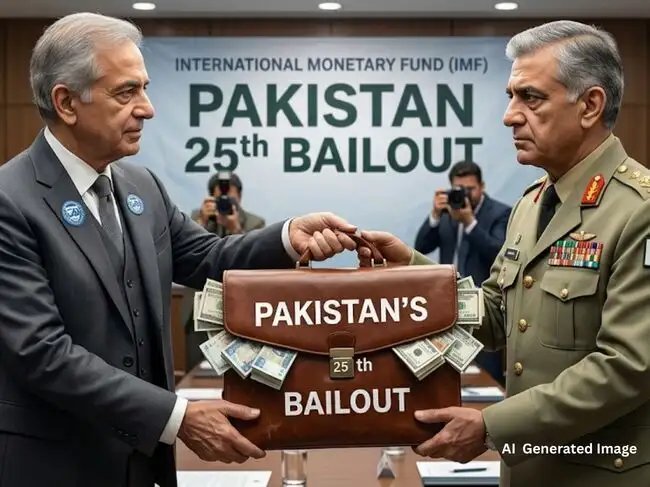
Pakistan's repeated dependence on International Monetary Fund (IMF) assistance, despite allegations of its links to terrorism and concerns over its economic management, has once again raised questions about why the global lender continues to extend financial support to the country. Former IMF First Deputy Managing Director Gita Gopinath has explained that the institution's primary responsibility is to prevent economic crises from worsening and affecting millions of people, while decisions on financial assistance are taken by its member countries rather than its management.
Gopinath addressed the issue during a conversation with entrepreneur and podcaster Raj Shamani. Responding to a question about why Pakistan continues to receive financial assistance despite repeatedly approaching the Fund and terrorism-related allegations, she pointed out that Pakistan is not the only country that has repeatedly borrowed from the IMF. Argentina, she noted, has also been a major and frequent recipient of its assistance.
She explained that the IMF was established to support countries experiencing severe economic difficulties. A financial crisis in one country does not remain confined within its borders, as it can affect millions of residents and create economic and security-related consequences for neighbouring nations.
Gopinath also noted that prolonged economic distress can create conditions in which terrorism and other destabilising activities flourish. However, she stressed that the decision to extend assistance rests with the IMF's member countries, including India, which collectively determine whether a country should receive a loan. It is not a decision taken independently by the IMF's management.
The number is significant because Pakistan has repeatedly returned to the Fund to address balance-of-payments difficulties, external financing requirements and economic instability. The IMF's lending history records successive arrangements across the 1960s, 1970s, 1980s, 1990s and the period after 2000.
The country's recent assistance includes a $7 billion Extended Fund Facility (EFF) approved in September 2024 and a separate Resilience and Sustainability Facility (RSF) arrangement approved in May 2025. It had also received a $3 billion Stand-By Arrangement in 2023.
During the podcast, Shamani referred to Pakistan having sought IMF assistance 28 times over 35 years. However, a separate count of its lending arrangements since 1958 puts the total at 25. The distinction matters because the number can vary depending on whether individual lending facilities and emergency financing instruments are counted separately.
The following table ranks the 10 countries with the highest outstanding IMF credit, based on their total balances in Special Drawing Rights (SDRs).
Source: IMF credit outstanding data as of October 31, 2026. SDR is an international reserve asset created by the IMF and is not a conventional currency.
Argentina is considerably ahead of other countries, with outstanding IMF credit of nearly 42 billion SDRs. Pakistan's outstanding balance stands at approximately 7.88 billion SDRs, putting it ahead of Egypt, Ecuador and other major borrowers.
It is important to distinguish between the frequency of borrowing and the amount currently owed. A country that has approached the IMF more often does not necessarily have the largest outstanding debt. The table reflects current credit balances, not the total number of historical bailout programmes.
The voting power of each member is largely determined by its quota, which reflects its relative position in the global economy. Members also receive basic votes, giving smaller economies a degree of representation in the institution's decision-making process.
The United States has the largest voting share, followed by Japan, China and Germany. India holds 2.63% of the total voting power.
Source: IMF members' quota and voting power data.
The IMF's Executive Board, which conducts the institution's day-to-day business, comprises 25 directors elected by member countries or groups of countries. Decisions are taken through this board, with voting power weighted according to members' shares.
The United States has an effective veto over certain major decisions that require an 85% supermajority because its voting share exceeds 15%. However, this does not mean Washington can independently approve or block every individual bailout. Most routine decisions, including the approval of individual lending programmes, require a simple majority.
This distinction is important when examining Pakistan's repeated financial assistance. The decision to extend a loan is not simply a matter of the IMF management choosing to support a country. It is part of a collective decision-making process involving its member nations.
Gopinath's explanation therefore places Pakistan's bailouts within the IMF's broader mandate of addressing economic crises and preventing their consequences from spreading beyond national borders.
(You can now subscribe to our Economic Times WhatsApp channel)
Gopinath addressed the issue during a conversation with entrepreneur and podcaster Raj Shamani. Responding to a question about why Pakistan continues to receive financial assistance despite repeatedly approaching the Fund and terrorism-related allegations, she pointed out that Pakistan is not the only country that has repeatedly borrowed from the IMF. Argentina, she noted, has also been a major and frequent recipient of its assistance.
She explained that the IMF was established to support countries experiencing severe economic difficulties. A financial crisis in one country does not remain confined within its borders, as it can affect millions of residents and create economic and security-related consequences for neighbouring nations.
Gopinath also noted that prolonged economic distress can create conditions in which terrorism and other destabilising activities flourish. However, she stressed that the decision to extend assistance rests with the IMF's member countries, including India, which collectively determine whether a country should receive a loan. It is not a decision taken independently by the IMF's management.
How many times has Pakistan received IMF bailouts?
Pakistan is among the most frequent borrowers from the IMF. It has entered into 25 lending arrangements since 1958, according to the Pakistan-focused IFI Monitor tracker. Its first arrangement was approved in December 1958, although the country did not withdraw any money under that agreement.
The number is significant because Pakistan has repeatedly returned to the Fund to address balance-of-payments difficulties, external financing requirements and economic instability. The IMF's lending history records successive arrangements across the 1960s, 1970s, 1980s, 1990s and the period after 2000.
The country's recent assistance includes a $7 billion Extended Fund Facility (EFF) approved in September 2024 and a separate Resilience and Sustainability Facility (RSF) arrangement approved in May 2025. It had also received a $3 billion Stand-By Arrangement in 2023.
During the podcast, Shamani referred to Pakistan having sought IMF assistance 28 times over 35 years. However, a separate count of its lending arrangements since 1958 puts the total at 25. The distinction matters because the number can vary depending on whether individual lending facilities and emergency financing instruments are counted separately.
Top 10 countries with the highest outstanding IMF loans
Pakistan is also among the world's largest current IMF debtors. The Fund's financial data for October 31, 2026, places it third in terms of outstanding credit, behind Argentina and Ukraine.The following table ranks the 10 countries with the highest outstanding IMF credit, based on their total balances in Special Drawing Rights (SDRs).
| Rank | Country | Outstanding IMF credit (billion SDRs) |
| 1 | Argentina | 41.97 |
| 2 | Ukraine | 10.50 |
| 3 | Pakistan | 7.88 |
| 4 | Egypt | 7.86 |
| 5 | Ecuador | 6.91 |
| 6 | Cote d'Ivoire | 4.12 |
| 7 | Ghana | 2.89 |
| 8 | Bangladesh | 2.87 |
| 9 | Kenya | 2.83 |
| 10 | Democratic Republic of Congo | 2.40 |
Argentina is considerably ahead of other countries, with outstanding IMF credit of nearly 42 billion SDRs. Pakistan's outstanding balance stands at approximately 7.88 billion SDRs, putting it ahead of Egypt, Ecuador and other major borrowers.
It is important to distinguish between the frequency of borrowing and the amount currently owed. A country that has approached the IMF more often does not necessarily have the largest outstanding debt. The table reflects current credit balances, not the total number of historical bailout programmes.
How does IMF voting power work? Which countries have the biggest say?
Gopinath's explanation also brings attention to how the IMF makes decisions. Although the institution's management and staff assess economic conditions and recommend financial programmes, lending decisions are taken through its governance structure, where member countries exercise voting rights.The voting power of each member is largely determined by its quota, which reflects its relative position in the global economy. Members also receive basic votes, giving smaller economies a degree of representation in the institution's decision-making process.
The United States has the largest voting share, followed by Japan, China and Germany. India holds 2.63% of the total voting power.
Top 10 countries by IMF voting power
| Rank | Country | Voting power |
| 1 | United States | 16.49% |
| 2 | Japan | 6.14% |
| 3 | China | 6.08% |
| 4 | Germany | 5.31% |
| 5 | France | 4.03% |
| 6 | United Kingdom | 4.03% |
| 7 | Italy | 3.02% |
| 8 | India | 2.63% |
| 9 | Russia | 2.59% |
| 10 | Brazil | 2.22% |
The IMF's Executive Board, which conducts the institution's day-to-day business, comprises 25 directors elected by member countries or groups of countries. Decisions are taken through this board, with voting power weighted according to members' shares.
The United States has an effective veto over certain major decisions that require an 85% supermajority because its voting share exceeds 15%. However, this does not mean Washington can independently approve or block every individual bailout. Most routine decisions, including the approval of individual lending programmes, require a simple majority.
This distinction is important when examining Pakistan's repeated financial assistance. The decision to extend a loan is not simply a matter of the IMF management choosing to support a country. It is part of a collective decision-making process involving its member nations.
Gopinath's explanation therefore places Pakistan's bailouts within the IMF's broader mandate of addressing economic crises and preventing their consequences from spreading beyond national borders.
Add  as a Reliable and Trusted News Source
 Add Now!
(You can now subscribe to our Economic Times WhatsApp channel)












 ETPrime Membership