



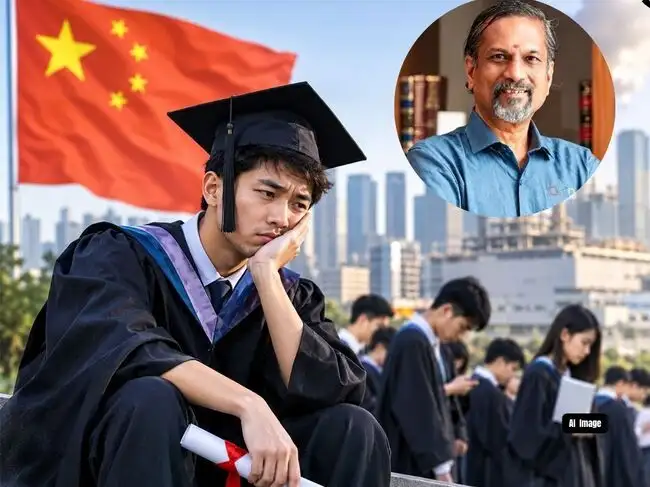
China's position as the world's manufacturing powerhouse has not translated into enough employment opportunities for its young graduates. Despite its massive industrial capacity, advanced technology ecosystem and a merchandise trade surplus of nearly $1.2 trillion, the country is struggling to provide jobs to a growing section of its educated youth. The academic qualifications are no longer guaranteeing a stable career. Zoho founder Sridhar Vembu has drawn attention to this growing challenge, warning that India could face a similar problem in the coming years. He believes the traditional employment model, which encourages students to study for years before securing a regular salaried job, is increasingly becoming difficult to sustain.
One particularly concerning aspect is the educational background of unemployed young people. According to the figures highlighted by Vembu, approximately 70% of unemployed individuals in China's 20-24 age group have university degrees. This suggests that the challenge is not simply about a shortage of skilled workers. Instead, there appears to be a growing mismatch between the qualifications young people acquire and the opportunities available in the job market.
For many years, China's younger generation followed a familiar path. Education was considered the route to financial security, better employment and a more comfortable life than their parents had experienced. However, that expectation is becoming increasingly difficult to fulfil.
Technology is adding another layer of uncertainty. Automation and artificial intelligence are changing how businesses operate, reducing their dependence on certain categories of human labour and putting several traditional job roles under pressure. This could make the employment challenge more serious in the coming years. Even students with university degrees may find themselves competing for a limited number of positions.
The concern is particularly relevant for countries where millions of young people enter the workforce every year. An education system designed primarily around securing salaried employment may struggle to prepare them for a job market undergoing rapid technological changes.
The widespread availability of salaried jobs in large industrial and corporate organisations, he points out, is a relatively recent development. According to Vembu, economies need to move beyond the assumption that every educated young person must find employment in an established organisation. More opportunities should be created for people to start businesses, work independently and build their own sources of income.
Such a shift would also require a change in how young people are prepared for their professional lives. Practical business skills, the ability to identify opportunities and an entrepreneurial mindset could become increasingly important alongside formal academic qualifications.
Vembu's warning raises an important question: Is India preparing its young population for the jobs that will actually exist in the future? If education continues to focus predominantly on producing graduates seeking conventional salaried positions, the gap between the number of job seekers and available opportunities could widen.
Encouraging entrepreneurship, supporting small businesses and making self-employment more accessible could help address this challenge. The larger question is whether India's education and economic policies can adapt quickly enough.
China's experience offers a warning that industrial strength, technological progress and a growing number of university graduates do not automatically guarantee employment. For India, the challenge may not be limited to creating more jobs. It may also involve preparing an entire generation to create opportunities of its own.
(You can now subscribe to our Economic Times WhatsApp channel)
China faces an employment crisis among educated youth
China's employment situation presents an unusual contradiction. The country has built a formidable manufacturing industry, developed technological capabilities across several sectors and established itself as a major global exporter. Yet, these achievements have not created enough suitable jobs for its younger population.One particularly concerning aspect is the educational background of unemployed young people. According to the figures highlighted by Vembu, approximately 70% of unemployed individuals in China's 20-24 age group have university degrees. This suggests that the challenge is not simply about a shortage of skilled workers. Instead, there appears to be a growing mismatch between the qualifications young people acquire and the opportunities available in the job market.
For many years, China's younger generation followed a familiar path. Education was considered the route to financial security, better employment and a more comfortable life than their parents had experienced. However, that expectation is becoming increasingly difficult to fulfil.

Why traditional salaried jobs may become harder to find
Vembu believes the problem goes beyond China. Modern education systems and economic structures across the world have largely prepared students for conventional employment, where completing a degree is followed by a steady monthly salary. However, the number of such opportunities is not increasing at the pace required.Technology is adding another layer of uncertainty. Automation and artificial intelligence are changing how businesses operate, reducing their dependence on certain categories of human labour and putting several traditional job roles under pressure. This could make the employment challenge more serious in the coming years. Even students with university degrees may find themselves competing for a limited number of positions.
The concern is particularly relevant for countries where millions of young people enter the workforce every year. An education system designed primarily around securing salaried employment may struggle to prepare them for a job market undergoing rapid technological changes.
Sridhar Vembu suggests entrepreneurship as a solution
Rather than relying heavily on traditional corporate employment, Vembu believes countries need to encourage entrepreneurship and self-employment on a much larger scale.He argues that economic prosperity was not always built around large companies offering permanent jobs. In the United States, independent businesses and entrepreneurship played an important role in creating wealth and employment well into the middle of the 20th century.The widespread availability of salaried jobs in large industrial and corporate organisations, he points out, is a relatively recent development. According to Vembu, economies need to move beyond the assumption that every educated young person must find employment in an established organisation. More opportunities should be created for people to start businesses, work independently and build their own sources of income.
Such a shift would also require a change in how young people are prepared for their professional lives. Practical business skills, the ability to identify opportunities and an entrepreneurial mindset could become increasingly important alongside formal academic qualifications.
Why Vembu's warning matters for India
India has a large young population entering the employment market, making the Chinese experience particularly relevant for its policymakers. The country's economic growth and expanding technology sector have created opportunities across several industries. However, the growing use of AI and automation could change the nature of employment even in sectors traditionally considered attractive to graduates.Vembu's warning raises an important question: Is India preparing its young population for the jobs that will actually exist in the future? If education continues to focus predominantly on producing graduates seeking conventional salaried positions, the gap between the number of job seekers and available opportunities could widen.
Encouraging entrepreneurship, supporting small businesses and making self-employment more accessible could help address this challenge. The larger question is whether India's education and economic policies can adapt quickly enough.
China's experience offers a warning that industrial strength, technological progress and a growing number of university graduates do not automatically guarantee employment. For India, the challenge may not be limited to creating more jobs. It may also involve preparing an entire generation to create opportunities of its own.
Add  as a Reliable and Trusted News Source
 Add Now!
(You can now subscribe to our Economic Times WhatsApp channel)












 ETPrime Membership


















