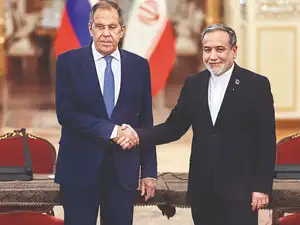
Foreign Minister Araghchi claims Moscow & Tehran have never worked so closely before
Iran has deliberately prolonged talks with the US to try to weaken Donald Trump politically ahead of November's US midterm elections, senior officials say, while fears of renewed military action and deep distrust of Washington have reinforced Tehran's reluctance to strike a quick deal to end the war.
Three senior Iranian officials and an Iranian insider, speaking on condition of anonymity, said Tehran was convinced the US president was ready to resort to renewed attacks to try to break the stalemate in the eight-month-old war.
"Iran is preparing for renewed Israeli and US attacks, not for a deal with America to end the war," one of the officials said. "The clerical establishment is determined not to give Trump a political victory."
Tehran analyst Saeed Leylaz said that, by prolonging the talks, "Iran is influencing the US election without taking any unlawful action". Trump has repeatedly said he expects oil prices to drop after the elections, but has not offered a detailed plan to end the war and reopen the Strait of Hormuz, a vital global energy shipping route effectively closed by Iran since the war began.
Exploiting Trump's problems
The war, which began in February when the US and its ally Israel launched strikes on Iran, has helped drive Trump's approval rating to a record low as polls suggest that Americans worried about high gasoline prices will punish his Republican Party in the November 3 congressional elections.
Aragchi, Lavrov meet
Iranian Foreign Minister Abbas Araghchi said Tuesday that Russia and Iran have "never" worked so closely, after hosting his Russian counterpart Sergey Lavrov first visit since the outbreak of the conflict as Moscow seeks to play a mediating role in the West Asian war.
"Never in our history have Iran & Russia worked as closely as now," Araghchi wrote on X.
(You can now subscribe to our Economic Times WhatsApp channel)
Three senior Iranian officials and an Iranian insider, speaking on condition of anonymity, said Tehran was convinced the US president was ready to resort to renewed attacks to try to break the stalemate in the eight-month-old war.
"Iran is preparing for renewed Israeli and US attacks, not for a deal with America to end the war," one of the officials said. "The clerical establishment is determined not to give Trump a political victory."
Tehran analyst Saeed Leylaz said that, by prolonging the talks, "Iran is influencing the US election without taking any unlawful action". Trump has repeatedly said he expects oil prices to drop after the elections, but has not offered a detailed plan to end the war and reopen the Strait of Hormuz, a vital global energy shipping route effectively closed by Iran since the war began.
Exploiting Trump's problems

The war, which began in February when the US and its ally Israel launched strikes on Iran, has helped drive Trump's approval rating to a record low as polls suggest that Americans worried about high gasoline prices will punish his Republican Party in the November 3 congressional elections.
Aragchi, Lavrov meet
Iranian Foreign Minister Abbas Araghchi said Tuesday that Russia and Iran have "never" worked so closely, after hosting his Russian counterpart Sergey Lavrov first visit since the outbreak of the conflict as Moscow seeks to play a mediating role in the West Asian war.
"Never in our history have Iran & Russia worked as closely as now," Araghchi wrote on X.
Add  as a Reliable and Trusted News Source
 Add Now!
(You can now subscribe to our Economic Times WhatsApp channel)
Read More News on
Read More News on



















 ETPrime Membership