 ET Bureau
A recent agreement between Ivanhoe Atlantic and Pakistan's Mari Minerals raises concerns over US-China connections in mining.
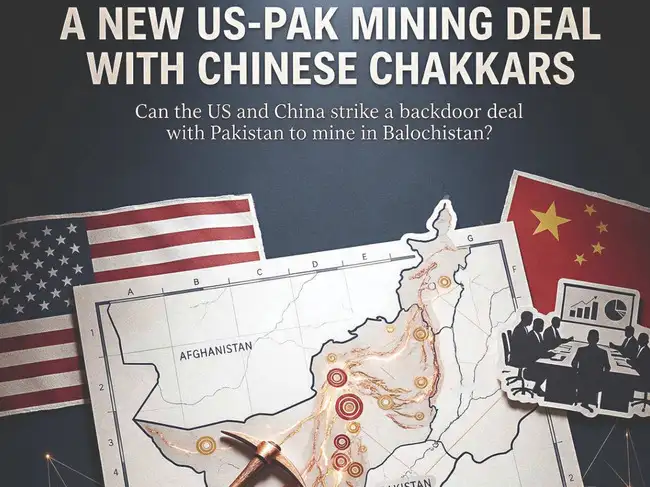
New Delhi: Can the US and China strike a backdoor deal with Pakistan to mine in Balochistan? It may appear far-fetched, but a curious deal, signed with the approval of the Trump Administration, between US mining entity Ivanhoe Atlantic (IA) and Pakistan's Mari Minerals on November 13 in Islamabad has all the makings of such a possibility.
On the face of it, the deal is to set up a joint venture for "greenfield exploration across a package of highly prospective licenses in the Province of Balochistan". But, it's the roots of these entities that raise several red flags. They link Chinese state-owned entities to Ivanhoe's founder Robert Friedland, his African mining interests, the US government and eventually Pakistan Army's $5.9-b-worth 'Fauji Foundation'.
Friedland, the billionaire American miner, holds majority stakes in Ivanhoe Atlantic through his company I-Pulse Inc., which in June received a $250m CHIPS R&D grant from the US Department of Commerce. However, he is also the founder and co-chair of Toronto-registered Ivanhoe Mines, a sister concern, which is 33.4% owned by two state-linked Chinese companies that were once termed 'risks' by US authorities on grounds of security and human rights.
China International Trust and Investment Corporation (CITIC) , which is wholly owned by the Chinese finance ministry, is the largest shareholder in Ivanhoe Mines, with a 21.2% stake. Another 12.2% is held by Zijin Mining, a company owned by the State Finance Bureau of Shanghang County.
Friedland, the largest individual shareholder with an 11.5% stake, struck a major $412 million deal in 2015 with CITIC and Zijin Mining, allowing them controlling stake in the Kamoa Copper Mine in Congo. Interestingly, Ivanhoe Mines has a modest investment of $68.4m in I-Pulse, which controls IA.
Ivanhoe Atlantic (IA) and Friedman's Chinese connections came under intense political scrutiny in the US last December after the US State Department supported their $1.8b deal with Liberia to build a rail link for transporting iron ore. Republican Congressman John Moolenaar, who heads the House Select Committee on China, shot off a letter to US Secretary of State Marco Rubio on December 9, 2025, strongly objecting to the Trump Administration's endorsement of Ivanhoe.
In his letter mentioning the link between IA and Ivanhoe Mines, he wrote that in 2022 the US Federal Communications Commission had placed the telecom services controlled by CITIC on the 'Covered List' for posing 'unacceptable risk' to US national security. Zijin, he added, was placed on the Entity List under the Uyghur Forced Labour Prevention Act. He also highlighted that, in 2024, the Senate Foreign Relations Committee had blocked a proposal by IA's earlier avatar HPX to establish a railway authority in Liberia.
Moolenaar's letter kicked up a political storm but earned only partial redressal. Friedland was forced to overhaul the IA board earlier this year by removing two China-linked members - also highlighted by Moolenaar in his letter - Peter Tsang and Kenneth Lau. And to placate Republican anger on Trump, he brought former Special Envoy for Sahel region in Africa Peter Pham as IA's Executive Chairman.
But nothing changed in sister concern Ivanhoe Mines, where CITIC and Zijin have continued to retain control. As a result, the Frieland-Ivanhoe Mines- CITIC-Zijin-IPlus-IA link remains unaltered with Pakistan's Mari Minerals, which also has a 5% stake in another Sino-Pak mining JV, now added to the chain.
On the Pakistan side, the chain loops back to China through Mari Energies Ltd, of which Mari Minerals is a wholly owned subsidiary. The largest stake of 40% in Mari Energies is with Pakistan military-run trust 'Fauji Foundation' (FF).
This Foundation has deep commercial ties with Chinese entities across sectors - fertilisers, cement, logistics and energy among others - through the China-Pakistan Economic Corridor programme and outside.
$1.1 b deal for a coal-to-urea project with China's Hualu Engineering
Fauji Cement has tied with state-owned Chinese entity SINOMA to set up a greenfield cement factory in Dera Ghazi Khan
Friedland, who incidentally was a close friend of Apple founder Steve Job, is said to have traveled to India for spiritual purposes in the past but is emerging as a source of concern now. He has also supported Trump's tariff policies and the push for mining more in the US.
But like Nvidia, Friedland has kept his Chinese links in play through Trump 2.0, extending them now to Pakistan and raising once again questions on the nature of backhanded US-China-Pakistan business deals which consistently blur the lines of state and business interests.
(You can now subscribe to our Economic Times WhatsApp channel)
On the face of it, the deal is to set up a joint venture for "greenfield exploration across a package of highly prospective licenses in the Province of Balochistan". But, it's the roots of these entities that raise several red flags. They link Chinese state-owned entities to Ivanhoe's founder Robert Friedland, his African mining interests, the US government and eventually Pakistan Army's $5.9-b-worth 'Fauji Foundation'.
Friedland, the billionaire American miner, holds majority stakes in Ivanhoe Atlantic through his company I-Pulse Inc., which in June received a $250m CHIPS R&D grant from the US Department of Commerce. However, he is also the founder and co-chair of Toronto-registered Ivanhoe Mines, a sister concern, which is 33.4% owned by two state-linked Chinese companies that were once termed 'risks' by US authorities on grounds of security and human rights.
China International Trust and Investment Corporation (CITIC) , which is wholly owned by the Chinese finance ministry, is the largest shareholder in Ivanhoe Mines, with a 21.2% stake. Another 12.2% is held by Zijin Mining, a company owned by the State Finance Bureau of Shanghang County.
Friedland, the largest individual shareholder with an 11.5% stake, struck a major $412 million deal in 2015 with CITIC and Zijin Mining, allowing them controlling stake in the Kamoa Copper Mine in Congo. Interestingly, Ivanhoe Mines has a modest investment of $68.4m in I-Pulse, which controls IA.

Ivanhoe Atlantic (IA) and Friedman's Chinese connections came under intense political scrutiny in the US last December after the US State Department supported their $1.8b deal with Liberia to build a rail link for transporting iron ore. Republican Congressman John Moolenaar, who heads the House Select Committee on China, shot off a letter to US Secretary of State Marco Rubio on December 9, 2025, strongly objecting to the Trump Administration's endorsement of Ivanhoe.
In his letter mentioning the link between IA and Ivanhoe Mines, he wrote that in 2022 the US Federal Communications Commission had placed the telecom services controlled by CITIC on the 'Covered List' for posing 'unacceptable risk' to US national security. Zijin, he added, was placed on the Entity List under the Uyghur Forced Labour Prevention Act. He also highlighted that, in 2024, the Senate Foreign Relations Committee had blocked a proposal by IA's earlier avatar HPX to establish a railway authority in Liberia.
Moolenaar's letter kicked up a political storm but earned only partial redressal. Friedland was forced to overhaul the IA board earlier this year by removing two China-linked members - also highlighted by Moolenaar in his letter - Peter Tsang and Kenneth Lau. And to placate Republican anger on Trump, he brought former Special Envoy for Sahel region in Africa Peter Pham as IA's Executive Chairman.
But nothing changed in sister concern Ivanhoe Mines, where CITIC and Zijin have continued to retain control. As a result, the Frieland-Ivanhoe Mines- CITIC-Zijin-IPlus-IA link remains unaltered with Pakistan's Mari Minerals, which also has a 5% stake in another Sino-Pak mining JV, now added to the chain.
On the Pakistan side, the chain loops back to China through Mari Energies Ltd, of which Mari Minerals is a wholly owned subsidiary. The largest stake of 40% in Mari Energies is with Pakistan military-run trust 'Fauji Foundation' (FF).
This Foundation has deep commercial ties with Chinese entities across sectors - fertilisers, cement, logistics and energy among others - through the China-Pakistan Economic Corridor programme and outside.
Some examples:
FF has 30% stake in Thar Energy Ltd with China Machinery Engineering Corporation$1.1 b deal for a coal-to-urea project with China's Hualu Engineering
Fauji Cement has tied with state-owned Chinese entity SINOMA to set up a greenfield cement factory in Dera Ghazi Khan
Friedland, who incidentally was a close friend of Apple founder Steve Job, is said to have traveled to India for spiritual purposes in the past but is emerging as a source of concern now. He has also supported Trump's tariff policies and the push for mining more in the US.
But like Nvidia, Friedland has kept his Chinese links in play through Trump 2.0, extending them now to Pakistan and raising once again questions on the nature of backhanded US-China-Pakistan business deals which consistently blur the lines of state and business interests.
Add  as a Reliable and Trusted News Source
 Add Now!
(You can now subscribe to our Economic Times WhatsApp channel)


















 ETPrime Membership