



Listen to this article in summarized format
×
Subscribe to

Unlock AI Briefing and Premium Content
New Year Offer 24 Hours Left
Subscribe NowAlready a member? Sign In
What's Included
- Exclusive Stories
- Daily ePaper Access
- Smart Market Tools
- Curated Investment Ideas
- Ad-lite Experience
Subscription

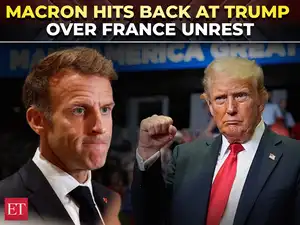
French President Emmanuel Macron on Wednesday took an apparent swipe at US President Donald Trump and Israeli Prime Minister Benjamin Netanyahu, accusing foreign leaders of exploiting France’s recent unrest to advance their own political agendas.
Macron criticised what he called “unacceptable and stupid comments” about the violence, alleging that misleading claims and artificial intelligence-generated images were being used to portray France as overrun by migrants and Islamists.
His remarks came after Trump linked the unrest to immigration and warned that Paris would soon become a “Muslim city”, while Netanyahu accused French authorities of giving in to what he described as an “invasion of extremist Islam”.
Also Read: From France to Italy, Belgium and Spain: Housing crisis, rising costs, education fuel wave of protests across Europe
“There are people who campaign at France's expense — leaders who are in campaign mode, whether here in the region or on the other side of the Atlantic,” Macron said during a visit to Doha, Qatar, as part of a three-day tour of the Gulf region.
Macron said there was no visible foreign interference in the events that triggered the unrest, but alleged that foreign leaders had spread misleading information in its aftermath.
“As far as I'm concerned, there is no visible foreign interference in the events that took place. There has been foreign manipulation of information in the aftermath, which led to equally unacceptable and stupid comments from many people, including foreign leaders,” he said, according to Euronews.
When asked directly whether his remarks were aimed at Trump, Macron replied, “Among others, yes.”
The French President also criticised the circulation of artificial intelligence-generated images depicting events that had not occurred in France, as well as claims that the country had been overrun by migrants and Islamists.
“That is to say, we've seen AI-generated images showing scenes that never actually happened in France. We have people who explained that we had been invaded by hordes of migrants and Islamists”, he said.
“In these moments, we see who loves France and who doesn't. And the fact is, all the people who are speaking ill of our country right now are people who do not love our country. So, those people really annoy me,” Macron added.
Also Read: France tightens security ahead of fresh protests; curfews, public gathering bans imposed
On Monday, Trump claimed that France was “under siege, looted and set ablaze by migrants, jihadists and communists”, warning that similar consequences awaited the US if Democrats won.
Speaking to reporters outside the White House, Trump described the situation in France as “a very sad situation” and argued that immigration, rather than education or domestic policy, was responsible for the unrest.
“Well, France, it is a very sad situation what’s happening in France, because what’s happening in France has to do with immigration, not schools, not anything. It’s immigration,” Trump said.
He also predicted that Paris would soon become a “Muslim city”, criticising Macron for not closing France’s borders.
“And, as you know, Paris is going to be a Muslim city very soon. And that wasn’t the deal. That wasn’t the deal. I told Emmanuel, you should close up your borders,” Trump added.
Trump said Macron was a friend but had made a mistake by allowing people from across the world to enter France.
In an interview with French-language network i24News on Tuesday, Netanyahu said France had failed to prepare adequately for the disorder, according to the Times of Israel.
“They did not prepare in time; they simply gave up. They succumbed to the invasion of extremist Islam,” he said.
Asked what advice he would give France, Netanyahu said: “Fight back, do not pursue a policy of appeasement — fight against the extremists.”
His remarks came as France continued to grapple with the aftermath of demonstrations, looting and clashes with law enforcement over the weekend. Trade unions, the Yellow Vest movement and student groups organised demonstrations, most of which were peaceful, but violence and looting on Saturday overshadowed the marches.
In Bordeaux, local authorities announced a week-long night curfew for unaccompanied minors after widespread looting in the city centre over the weekend.
The order, announced on Monday by Sophie Brocas, prefect of Gironde and Nouvelle-Aquitaine, took effect on Tuesday and will remain in place until the morning of October 26. It bars people under 18 from public spaces between 10 pm and 7 am unless accompanied by a parent or legal guardian.
The restrictions followed riots on October 17, which officials described as involving an “unprecedented level of violence”. Several thousand rioters targeted commercial areas in central Bordeaux, smashing storefronts and ransacking shops.
Authorities deployed 400 police officers and gendarmes, supported by two water cannons and two armoured vehicles, to contain the violence. Nearly 120 people were arrested over Saturday and Sunday and face prosecution.
At least 2,400 people were arrested following the wider unrest, during which town halls were set on fire and hundreds of businesses were looted or damaged, according to the report.
Macron is expected to convene an emergency meeting with cabinet ministers and intelligence officials on Thursday after returning to Paris. The meeting will review the October 17 events, with the President seeking a “detailed account” of what happened.
Meanwhile, Macron’s Gulf tour is also aimed at securing France’s energy supplies amid a national cost-of-living crisis. The French President has said that ensuring access to diesel and gas is among the key objectives of the visit, as the government seeks to ease energy-price pressures and social tensions.
(You can now subscribe to our Economic Times WhatsApp channel)
Macron criticised what he called “unacceptable and stupid comments” about the violence, alleging that misleading claims and artificial intelligence-generated images were being used to portray France as overrun by migrants and Islamists.
His remarks came after Trump linked the unrest to immigration and warned that Paris would soon become a “Muslim city”, while Netanyahu accused French authorities of giving in to what he described as an “invasion of extremist Islam”.
Also Read: From France to Italy, Belgium and Spain: Housing crisis, rising costs, education fuel wave of protests across Europe
“There are people who campaign at France's expense — leaders who are in campaign mode, whether here in the region or on the other side of the Atlantic,” Macron said during a visit to Doha, Qatar, as part of a three-day tour of the Gulf region.

Macron said there was no visible foreign interference in the events that triggered the unrest, but alleged that foreign leaders had spread misleading information in its aftermath.
“As far as I'm concerned, there is no visible foreign interference in the events that took place. There has been foreign manipulation of information in the aftermath, which led to equally unacceptable and stupid comments from many people, including foreign leaders,” he said, according to Euronews.
When asked directly whether his remarks were aimed at Trump, Macron replied, “Among others, yes.”
The French President also criticised the circulation of artificial intelligence-generated images depicting events that had not occurred in France, as well as claims that the country had been overrun by migrants and Islamists.
“That is to say, we've seen AI-generated images showing scenes that never actually happened in France. We have people who explained that we had been invaded by hordes of migrants and Islamists”, he said.
“In these moments, we see who loves France and who doesn't. And the fact is, all the people who are speaking ill of our country right now are people who do not love our country. So, those people really annoy me,” Macron added.
Trump links France unrest to immigration
Trump has repeatedly linked the unrest in France to immigration, using the violence to warn American voters about what he says could happen if Democrats prevail in the upcoming US midterm elections.Also Read: France tightens security ahead of fresh protests; curfews, public gathering bans imposed
On Monday, Trump claimed that France was “under siege, looted and set ablaze by migrants, jihadists and communists”, warning that similar consequences awaited the US if Democrats won.
Speaking to reporters outside the White House, Trump described the situation in France as “a very sad situation” and argued that immigration, rather than education or domestic policy, was responsible for the unrest.
“Well, France, it is a very sad situation what’s happening in France, because what’s happening in France has to do with immigration, not schools, not anything. It’s immigration,” Trump said.
He also predicted that Paris would soon become a “Muslim city”, criticising Macron for not closing France’s borders.
“And, as you know, Paris is going to be a Muslim city very soon. And that wasn’t the deal. That wasn’t the deal. I told Emmanuel, you should close up your borders,” Trump added.
Trump said Macron was a friend but had made a mistake by allowing people from across the world to enter France.
Netanyahu alleges ‘invasion of extremist Islam’
Netanyahu also criticised the French government’s handling of the unrest, alleging that radical Muslim groups were responsible for the turmoil.In an interview with French-language network i24News on Tuesday, Netanyahu said France had failed to prepare adequately for the disorder, according to the Times of Israel.
“They did not prepare in time; they simply gave up. They succumbed to the invasion of extremist Islam,” he said.
Asked what advice he would give France, Netanyahu said: “Fight back, do not pursue a policy of appeasement — fight against the extremists.”
His remarks came as France continued to grapple with the aftermath of demonstrations, looting and clashes with law enforcement over the weekend. Trade unions, the Yellow Vest movement and student groups organised demonstrations, most of which were peaceful, but violence and looting on Saturday overshadowed the marches.
France steps up security after unrest
French authorities have introduced curfews and strengthened security measures in several areas following the violence.In Bordeaux, local authorities announced a week-long night curfew for unaccompanied minors after widespread looting in the city centre over the weekend.
The order, announced on Monday by Sophie Brocas, prefect of Gironde and Nouvelle-Aquitaine, took effect on Tuesday and will remain in place until the morning of October 26. It bars people under 18 from public spaces between 10 pm and 7 am unless accompanied by a parent or legal guardian.
The restrictions followed riots on October 17, which officials described as involving an “unprecedented level of violence”. Several thousand rioters targeted commercial areas in central Bordeaux, smashing storefronts and ransacking shops.
Authorities deployed 400 police officers and gendarmes, supported by two water cannons and two armoured vehicles, to contain the violence. Nearly 120 people were arrested over Saturday and Sunday and face prosecution.
At least 2,400 people were arrested following the wider unrest, during which town halls were set on fire and hundreds of businesses were looted or damaged, according to the report.
Macron is expected to convene an emergency meeting with cabinet ministers and intelligence officials on Thursday after returning to Paris. The meeting will review the October 17 events, with the President seeking a “detailed account” of what happened.
Meanwhile, Macron’s Gulf tour is also aimed at securing France’s energy supplies amid a national cost-of-living crisis. The French President has said that ensuring access to diesel and gas is among the key objectives of the visit, as the government seeks to ease energy-price pressures and social tensions.
Add  as a Reliable and Trusted News Source
 Add Now!
(You can now subscribe to our Economic Times WhatsApp channel)
In Video:
‘Unacceptable, stupid’: Macron accuses foreign leaders of making political gain from France unrest
Read More News on
Read More News on


















 ETPrime Membership


















