



Listen to this article in summarized format
×
Subscribe to

Unlock AI Briefing and Premium Content
New Year Offer 24 Hours Left
Subscribe NowAlready a member? Sign In
What's Included
- Exclusive Stories
- Daily ePaper Access
- Smart Market Tools
- Curated Investment Ideas
- Ad-lite Experience
Subscription

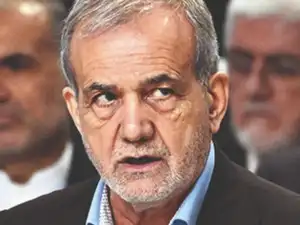
Masoud Pezeshkian warns sanctions could disrupt regional trade and energy
TEHRAN: Iranian President Masoud Pezeshkian said on Friday that peace negotiations would succeed only if conducted without "pressure and threats", as the months-long Middle East war remained deadlocked.
"Dialogue holds meaning and a chance of success only when based on mutual respect and mutual commitments, and when devoid of pressure and threat," he said at a summit of the Commonwealth of Independent States (CIS) in Turkmenistan.
"Negotiation conducted in the shadow of force is not negotiation, it is imposition and coercion," he added, warning that sanctions on Iran would affect "regional trade, connectivity, energy, and order".
His remarks came days after Pezeshkian described talks with the United States as futile, saying they had only led to renewed attacks. "With an enemy that every day resorts to assassination, sanctions, pressure and threats, and that breaks its commitments, negotiations are meaningless," he said on Monday.
The war began in late February with US and Israeli attacks on Iran, even as Washington and Tehran were engaged in negotiations over Iran's nuclear programme.
The warring parties agreed to a memorandum of understanding in June, outlining a framework for a permanent resolution to the conflict. However, Iranian attacks on vessels in the Strait of Hormuz prompted the resumption of US military operations.
Negotiations have remained largely stalled since then, with recent indirect talks between the two sides on the sidelines of the United Nations General Assembly failing to yield a breakthrough.
Washington has scaled back military operations in recent weeks, relying instead on economic pressure. The US has not struck Iran since September 1.
The US and Israel have maintained that the war is necessary to prevent Iran from acquiring nuclear weapons, a goal Tehran has long denied pursuing.
Attention has since shifted to reopening the Strait of Hormuz, whose closure has sent shockwaves through global energy markets.
(You can now subscribe to our Economic Times WhatsApp channel)
"Dialogue holds meaning and a chance of success only when based on mutual respect and mutual commitments, and when devoid of pressure and threat," he said at a summit of the Commonwealth of Independent States (CIS) in Turkmenistan.
"Negotiation conducted in the shadow of force is not negotiation, it is imposition and coercion," he added, warning that sanctions on Iran would affect "regional trade, connectivity, energy, and order".
His remarks came days after Pezeshkian described talks with the United States as futile, saying they had only led to renewed attacks. "With an enemy that every day resorts to assassination, sanctions, pressure and threats, and that breaks its commitments, negotiations are meaningless," he said on Monday.
The war began in late February with US and Israeli attacks on Iran, even as Washington and Tehran were engaged in negotiations over Iran's nuclear programme.

The warring parties agreed to a memorandum of understanding in June, outlining a framework for a permanent resolution to the conflict. However, Iranian attacks on vessels in the Strait of Hormuz prompted the resumption of US military operations.
Negotiations have remained largely stalled since then, with recent indirect talks between the two sides on the sidelines of the United Nations General Assembly failing to yield a breakthrough.
Washington has scaled back military operations in recent weeks, relying instead on economic pressure. The US has not struck Iran since September 1.
The US and Israel have maintained that the war is necessary to prevent Iran from acquiring nuclear weapons, a goal Tehran has long denied pursuing.
Attention has since shifted to reopening the Strait of Hormuz, whose closure has sent shockwaves through global energy markets.
Add  as a Reliable and Trusted News Source
 Add Now!
(You can now subscribe to our Economic Times WhatsApp channel)

