 ET Online
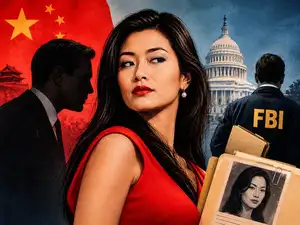
Nearly a decade before the Alice Huang controversy, another Chinese woman, Christine Fang, better known as Fang Fang, spent years building relationships with American politicians, fundraisers and mayors. (AI-generated image)
The allegations surrounding Nvidia CEO Jensen Huang and Chinese businesswoman Alice Huang have brought renewed attention to China's suspected use of women to cultivate relationships with influential Americans. But this is not an entirely new playbook.
Nearly a decade before the Alice Huang controversy, another Chinese woman, Christine Fang, better known as Fang Fang, spent years building relationships with American politicians, fundraisers and mayors.
ALSO READ | Could Jensen Huang's position as NVIDIA CEO be challenged? What the company's bylaws say
Newly declassified FBI files have now revealed details of her operation, including an intimate relationship with Congressman Eric Swalwell, alleged attempts to channel illegal campaign contributions and an extraordinary FBI effort to recruit her as an intelligence source. Fang returned to China in 2015 and was never prosecuted in the United States.
A student who became a political insider
Fang arrived in the San Francisco Bay Area around 2011 and enrolled at California State University, East Bay. She was in her late twenties or early thirties. Her student activities gave her an entry point into local politics. She became president of the university's Chinese Student Association and the campus chapter of the Asian Pacific Islander American Public Affairs Association (APAPA).
ALSO READ | Nvidia CEO Jensen Huang faces leadership questions as Republican senator calls for his resignation
Fang used these positions to organise events attended by politicians, business executives and Chinese consular officials. She became a familiar face at fundraisers, civic gatherings and conferences for American mayors. Her social media connections included elected officials, political operatives and members of politicians' families.
A December 2020 Axios investigation, based on interviews with current and former intelligence officials and people who knew Fang, reported that American investigators believed she was working for China's Ministry of State Security (MSS), the country's principal civilian intelligence agency. Her suspected handlers were believed to be based in China.
The FBI first noticed her while monitoring a suspected Chinese intelligence officer operating under diplomatic cover at the Chinese consulate in San Francisco. Fang and the suspected officer met or spoke repeatedly. Investigators subsequently began examining her political activities.
The FBI's Operation Rusty Thumbs
One of the most revealing disclosures in the August 2026 release of FBI files concerns an operation to recruit Fang herself.
In May 2013, an undercover FBI employee approached her in Las Vegas under a commercial cover. The bureau gave her the codename "Rusty Thumbs". The agent represented a fictitious company looking for someone with connections in China, knowledge of Chinese business and political circles and access to municipal governments around the Bay Area.
The FBI was exploring whether Fang could be turned into a confidential human source. Investigators believed her suspected connections to the MSS and Chinese government could make her useful in reporting on Beijing's influence activities in America.
An internal FBI assessment described her as motivated by "money and power". Agents considered her socially adept but noted personality traits they believed could complicate her suitability as a source. The FBI arranged further meetings and attempted to understand her ambitions and vulnerabilities.
An investigation of the files by The Bureau, published in August 2026, reported that FBI records identified both of Fang's parents internally as known MSS intelligence officers. This was an assessment within the bureau's files, not a publicly tested judicial finding.
The recruitment effort did not succeed. The FBI's subsequent investigation would focus on Fang's own activities and her connections with American politicians.
Swalwell, sex and congressional access
Fang's most consequential American contact was Eric Swalwell, then a rising Democratic politician from California. She met him around 2012, when he was a Dublin city council member and beginning his first congressional campaign.
Newly released FBI interview summaries provide a much clearer picture of their relationship than was previously available. In an interview with investigators in May 2015, Swalwell acknowledged having "physical relations" with Fang on a handful of occasions between 2012 and March 2015. He described the encounters as casual and said they had never dated or maintained a romantic relationship.
A second interview in March 2016 contained a particularly revealing account. Swalwell told investigators that Fang had arrived unexpectedly at his apartment on one occasion, banging on his door. He said he barely remembered the encounter because he had taken Ambien before she arrived. Swalwell was unmarried at the time.
These details, reported by the San Francisco Chronicle and ABC7 after the August 2026 declassification, establish that the relationship was physical. They do not establish that Swalwell knowingly cooperated with Chinese intelligence.
The political connection was more substantial than the personal one. Fang participated in fundraising for his 2014 re-election campaign and helped refer prospective interns to his office. At least one intern recommended through her network reportedly secured a position in his Washington office.
Swalwell told FBI agents that he regarded candidates Fang recommended as coming through APAPA (Asian Pacific American Public Affairs Association). In his 2015 and 2016 interviews, he identified her as his point of contact for the organisation. Swalwell joined the House Intelligence Committee in January 2015, giving him a role in overseeing America's intelligence agencies.
The campaign-finance investigation
The declassified files also reveal that the FBI investigated allegations that Fang was arranging campaign contributions through intermediaries in return for access to Swalwell and internships in his congressional offices.
The investigation, codenamed "Freshman Fifteen", was opened in March 2014. Investigators examined whether prospective interns were being offered positions in exchange for campaign contributions.
According to FBI financial analysis described in the released records, Fang had allegedly arranged contributions through intermediaries at least twice in 2013 and twice more in 2014. The suspected purpose was to conceal foreign-national involvement in campaign donations, which is prohibited under American election law.
In one reported instance, Fang allegedly told an intermediary she could arrange a meeting with Swalwell in return for a $5,000 campaign contribution. An internship would cost more, she reportedly indicated.
The FBI also examined whether Fang had solicited money from foreign nationals and whether she had falsified records or concealed the origins of donations.
But the crucial question was whether Swalwell knew about the alleged arrangement. Investigators did not establish that he had participated in a quid pro quo or knowingly accepted illegal contributions. In February 2017, the FBI concluded that its investigation had found no federal corruption violations by him and removed him as a subject.
The bureau's closing assessment was considerably more damaging to Fang. It identified evidence of possible federal election-law violations, false statements and acting as an unregistered foreign agent. But she was never prosecuted. A closing memorandum cited the fact that prosecution was "non-viable due to national security reasons".
Other politicians and the mayoral network
Swalwell was only one part of Fang's network. She volunteered for Ro Khanna's unsuccessful 2014 congressional campaign and helped organise a town hall involving Congresswoman Judy Chu. She appeared in photographs with former Congressman Mike Honda and California politician Ash Kalra at a Chinese Embassy event in Washington.
She also helped with a 2013 fundraiser for Tulsi Gabbard, although Gabbard's spokesperson said she did not recall meeting Fang.
Her relationships with mayors were even more concerning. Axios reported that Fang had romantic or sexual relationships with at least two Midwestern mayors over approximately three years. One mayor reportedly introduced her as his girlfriend at a 2014 conference in Washington.
An intelligence official also told Axios that an encounter between Fang and an Ohio mayor in a car was captured on FBI electronic surveillance. When the mayor asked why she was interested in him, she reportedly said she wanted to improve her English.
Fang also cultivated two other mayors and reportedly introduced one of them to the mayor of Shenzhen during a Chinese Embassy event and translated their conversation.
The FBI believed she was cultivating contacts who could rise to more influential positions. Its warning to a mayor in August 2015 described the approach as a long-term strategy of establishing relationships with local politicians and see how far they rise.
A sudden departure and an unfinished probe
Fang left America abruptly in mid-2015, shortly before a planned trip to Washington. The FBI had already briefed Swalwell and other politicians about her suspected intelligence connections.
She has not publicly resurfaced in the US. The FBI's investigation eventually closed without criminal charges against her. The House Ethics Committee separately investigated Swalwell's interactions with Fang and closed its inquiry in 2023 without taking action.
The larger significance of the case lies in what the FBI believed Fang was collecting. Investigators did not establish that she obtained classified government documents. Her suspected intelligence value was political access, information about influential people and the ability to cultivate relationships with officials who might eventually shape American policy.
Other Chinese women spies probed in the West
Fang was not the only Chinese woman to feature in Western counterintelligence investigations. In the US, Katrina Leung, a Chinese-American businesswoman and FBI informant, was accused of passing sensitive bureau information to China while maintaining intimate relationships with two FBI agents. The prosecution collapsed in 2005 after serious FBI misconduct came to light.
In Britain, Chinese-born lawyer Christine Lee was publicly identified by MI5 in 2022 over alleged political interference on behalf of China's United Front Work Department. She denied wrongdoing and was not criminally convicted.
Germany's case involving Yaqi X was more direct. Employed at Leipzig/Halle Airport, she was accused of passing flight and cargo information, including details concerning military shipments, to a suspected Chinese intelligence operative. A Dresden court convicted her in 2025 and imposed a suspended prison sentence.
The cases differ substantially in the evidence and legal outcomes but Fang's story offers a particularly revealing look at how counterintelligence officials believe political relationships can be cultivated long before their value becomes apparent. The Alice Huang allegations have revived that concern in the technology sector. In Fang's case, the FBI's own records show just how much of the operation had remained outside public view for more than a decade.
(You can now subscribe to our Economic Times WhatsApp channel)
Nearly a decade before the Alice Huang controversy, another Chinese woman, Christine Fang, better known as Fang Fang, spent years building relationships with American politicians, fundraisers and mayors.
ALSO READ | Could Jensen Huang's position as NVIDIA CEO be challenged? What the company's bylaws say
Newly declassified FBI files have now revealed details of her operation, including an intimate relationship with Congressman Eric Swalwell, alleged attempts to channel illegal campaign contributions and an extraordinary FBI effort to recruit her as an intelligence source. Fang returned to China in 2015 and was never prosecuted in the United States.
A student who became a political insider

Fang arrived in the San Francisco Bay Area around 2011 and enrolled at California State University, East Bay. She was in her late twenties or early thirties. Her student activities gave her an entry point into local politics. She became president of the university's Chinese Student Association and the campus chapter of the Asian Pacific Islander American Public Affairs Association (APAPA).
ALSO READ | Nvidia CEO Jensen Huang faces leadership questions as Republican senator calls for his resignation
Fang used these positions to organise events attended by politicians, business executives and Chinese consular officials. She became a familiar face at fundraisers, civic gatherings and conferences for American mayors. Her social media connections included elected officials, political operatives and members of politicians' families.
A December 2020 Axios investigation, based on interviews with current and former intelligence officials and people who knew Fang, reported that American investigators believed she was working for China's Ministry of State Security (MSS), the country's principal civilian intelligence agency. Her suspected handlers were believed to be based in China.
The FBI first noticed her while monitoring a suspected Chinese intelligence officer operating under diplomatic cover at the Chinese consulate in San Francisco. Fang and the suspected officer met or spoke repeatedly. Investigators subsequently began examining her political activities.
The FBI's Operation Rusty Thumbs
One of the most revealing disclosures in the August 2026 release of FBI files concerns an operation to recruit Fang herself.
In May 2013, an undercover FBI employee approached her in Las Vegas under a commercial cover. The bureau gave her the codename "Rusty Thumbs". The agent represented a fictitious company looking for someone with connections in China, knowledge of Chinese business and political circles and access to municipal governments around the Bay Area.
The FBI was exploring whether Fang could be turned into a confidential human source. Investigators believed her suspected connections to the MSS and Chinese government could make her useful in reporting on Beijing's influence activities in America.
An internal FBI assessment described her as motivated by "money and power". Agents considered her socially adept but noted personality traits they believed could complicate her suitability as a source. The FBI arranged further meetings and attempted to understand her ambitions and vulnerabilities.
An investigation of the files by The Bureau, published in August 2026, reported that FBI records identified both of Fang's parents internally as known MSS intelligence officers. This was an assessment within the bureau's files, not a publicly tested judicial finding.
The recruitment effort did not succeed. The FBI's subsequent investigation would focus on Fang's own activities and her connections with American politicians.
Swalwell, sex and congressional access
Fang's most consequential American contact was Eric Swalwell, then a rising Democratic politician from California. She met him around 2012, when he was a Dublin city council member and beginning his first congressional campaign.
Newly released FBI interview summaries provide a much clearer picture of their relationship than was previously available. In an interview with investigators in May 2015, Swalwell acknowledged having "physical relations" with Fang on a handful of occasions between 2012 and March 2015. He described the encounters as casual and said they had never dated or maintained a romantic relationship.
A second interview in March 2016 contained a particularly revealing account. Swalwell told investigators that Fang had arrived unexpectedly at his apartment on one occasion, banging on his door. He said he barely remembered the encounter because he had taken Ambien before she arrived. Swalwell was unmarried at the time.
These details, reported by the San Francisco Chronicle and ABC7 after the August 2026 declassification, establish that the relationship was physical. They do not establish that Swalwell knowingly cooperated with Chinese intelligence.
The political connection was more substantial than the personal one. Fang participated in fundraising for his 2014 re-election campaign and helped refer prospective interns to his office. At least one intern recommended through her network reportedly secured a position in his Washington office.
Swalwell told FBI agents that he regarded candidates Fang recommended as coming through APAPA (Asian Pacific American Public Affairs Association). In his 2015 and 2016 interviews, he identified her as his point of contact for the organisation. Swalwell joined the House Intelligence Committee in January 2015, giving him a role in overseeing America's intelligence agencies.
The campaign-finance investigation
The declassified files also reveal that the FBI investigated allegations that Fang was arranging campaign contributions through intermediaries in return for access to Swalwell and internships in his congressional offices.
The investigation, codenamed "Freshman Fifteen", was opened in March 2014. Investigators examined whether prospective interns were being offered positions in exchange for campaign contributions.
According to FBI financial analysis described in the released records, Fang had allegedly arranged contributions through intermediaries at least twice in 2013 and twice more in 2014. The suspected purpose was to conceal foreign-national involvement in campaign donations, which is prohibited under American election law.
In one reported instance, Fang allegedly told an intermediary she could arrange a meeting with Swalwell in return for a $5,000 campaign contribution. An internship would cost more, she reportedly indicated.
The FBI also examined whether Fang had solicited money from foreign nationals and whether she had falsified records or concealed the origins of donations.
But the crucial question was whether Swalwell knew about the alleged arrangement. Investigators did not establish that he had participated in a quid pro quo or knowingly accepted illegal contributions. In February 2017, the FBI concluded that its investigation had found no federal corruption violations by him and removed him as a subject.
The bureau's closing assessment was considerably more damaging to Fang. It identified evidence of possible federal election-law violations, false statements and acting as an unregistered foreign agent. But she was never prosecuted. A closing memorandum cited the fact that prosecution was "non-viable due to national security reasons".
Other politicians and the mayoral network
Swalwell was only one part of Fang's network. She volunteered for Ro Khanna's unsuccessful 2014 congressional campaign and helped organise a town hall involving Congresswoman Judy Chu. She appeared in photographs with former Congressman Mike Honda and California politician Ash Kalra at a Chinese Embassy event in Washington.
She also helped with a 2013 fundraiser for Tulsi Gabbard, although Gabbard's spokesperson said she did not recall meeting Fang.
Her relationships with mayors were even more concerning. Axios reported that Fang had romantic or sexual relationships with at least two Midwestern mayors over approximately three years. One mayor reportedly introduced her as his girlfriend at a 2014 conference in Washington.
An intelligence official also told Axios that an encounter between Fang and an Ohio mayor in a car was captured on FBI electronic surveillance. When the mayor asked why she was interested in him, she reportedly said she wanted to improve her English.
Fang also cultivated two other mayors and reportedly introduced one of them to the mayor of Shenzhen during a Chinese Embassy event and translated their conversation.
The FBI believed she was cultivating contacts who could rise to more influential positions. Its warning to a mayor in August 2015 described the approach as a long-term strategy of establishing relationships with local politicians and see how far they rise.
A sudden departure and an unfinished probe
Fang left America abruptly in mid-2015, shortly before a planned trip to Washington. The FBI had already briefed Swalwell and other politicians about her suspected intelligence connections.
She has not publicly resurfaced in the US. The FBI's investigation eventually closed without criminal charges against her. The House Ethics Committee separately investigated Swalwell's interactions with Fang and closed its inquiry in 2023 without taking action.
The larger significance of the case lies in what the FBI believed Fang was collecting. Investigators did not establish that she obtained classified government documents. Her suspected intelligence value was political access, information about influential people and the ability to cultivate relationships with officials who might eventually shape American policy.
Other Chinese women spies probed in the West
Fang was not the only Chinese woman to feature in Western counterintelligence investigations. In the US, Katrina Leung, a Chinese-American businesswoman and FBI informant, was accused of passing sensitive bureau information to China while maintaining intimate relationships with two FBI agents. The prosecution collapsed in 2005 after serious FBI misconduct came to light.
In Britain, Chinese-born lawyer Christine Lee was publicly identified by MI5 in 2022 over alleged political interference on behalf of China's United Front Work Department. She denied wrongdoing and was not criminally convicted.
Germany's case involving Yaqi X was more direct. Employed at Leipzig/Halle Airport, she was accused of passing flight and cargo information, including details concerning military shipments, to a suspected Chinese intelligence operative. A Dresden court convicted her in 2025 and imposed a suspended prison sentence.
The cases differ substantially in the evidence and legal outcomes but Fang's story offers a particularly revealing look at how counterintelligence officials believe political relationships can be cultivated long before their value becomes apparent. The Alice Huang allegations have revived that concern in the technology sector. In Fang's case, the FBI's own records show just how much of the operation had remained outside public view for more than a decade.
Add  as a Reliable and Trusted News Source
 Add Now!
(You can now subscribe to our Economic Times WhatsApp channel)


















 ETPrime Membership