Business News›News›International›US News›In 2020, New Jersey deployed a 150-foot steel caisson gate in 125 feet of water; the structure extends 30 feet above the seabed and is expected to last more than 75 years
The Economic Times daily newspaper is available online now.
In 2020, New Jersey deployed a 150-foot steel caisson gate in 125 feet of water; the structure extends 30 feet above the seabed and is expected to last more than 75 years
SECTIONS
In 2020, New Jersey deployed a 150-foot steel caisson gate in 125 feet of water; the structure extends 30 feet above the seabed and is expected to last more than 75 years
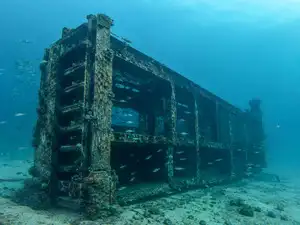
Underwater at Deepwater Reef in New Jersey, a caisson gate has been installed to form a new artificial reef. Designed to nurture marine biodiversity, this structure is expected to attract over 150 different species, from lobsters to crabs. Former studies suggest that creating artificial reefs can improve local fish populations when adequately maintained.
A representative image of a steel dry-dock gate on the seabed, serving as an artificial reef for marine life. Image credits: ChatGPT
A caisson gate, a massive steel barrier normally used to hold back water at the end of a dry dock, was towed off the Jersey Shore, lowered 125 feet underwater, and left there on purpose, with the expectation that it will remain for generations. According to a 2020 New Jersey Division of Fish & Wildlife report, state marine fisheries staff deployed a 150-foot caisson gate on the Deepwater Reef site on June 8, 2020. It's resting 125 feet in the water and 30 feet over the seafloor. The deployment raises questions about what was sunk, what now inhabits it, and whether the science supports the practice.
What's a caisson gate?
Per the New Jersey Division of Fish & Wildlife, a caisson gate dams off the open end of a dry dock. It is constructed of heavy-gauge steel plates with ballast in the keel to weigh it down. The same agency says The Sportfishing Fund, an organization devoted to building artificial reef sites, sponsored the gate's deployment. Not just anyone dumped it overboard. The state's announcement noted that such structures are emptied of machinery and fluids and cleaned. The U.S. Coast Guard and the state's Department of Environmental Protection conduct inspections on such structures before sinking.
According to the New Jersey Division of Fish & Wildlife, this number makes the deployment newsworthy: the gate, thanks to the thickness and quality of the steel, was expected to last more than 75 years, potentially into the late 2090s. That figure reflects the staff’s expectation rather than demonstrated performance. The caisson gate has been in place since 2020.
What lives there?
Live Events
The tenants aren't as glamorous as a Hollywood aquarium, but there are life forms. According to the state's announcement, artificial reef deployments have become home to more than 150 marine organisms. Among them are black sea bass, tautog, summer flounder, lobsters, crabs, and mussels. The agency also expects such sites to become magnets for scuba divers and anglers. So there are the marine life forms and the people who want to watch or catch them.
It's a fair question, and one that researchers have asked at scale. A 2020 systematic review article titled “Meta-Analysis Reveals Artificial Reefs Can Be Effective Tools for Fish Community Enhancement but Are Not One-Size-Fits-All,” by Paxton et al., published in the journal Frontiers in Marine Science, found that artificial reefs supported fish density, biomass, species richness, and diversity comparable to natural ones, solidified by the synthesis of 39 scientific studies on the topic. The authors compared the artificial reefs to rocky and coral ones.
Constructing an artificial reef underwater, using concrete breeze blocks. Image credits: Wikipedia
The same paper adds some caveats. The differences were linked to geographic areas and the materials of the reefs. The authors conclude that artificial reefs are not a one-size-fits-all solution and must be viewed strategically, based on where they are. There's a limit to how much that can say about this particular gate. The paper was published in May 2020, before the gate went down, and cannot speak directly to this structure. It speaks to the state of the field, and Deepwater Reef's performance will have to be measured over time.
The cleanup
Old ships and structures come with baggage, which is why that clean-up step is important. According to the U.S. Environmental Protection Agency (EPA), materials of concern aboard vessels can include fuels and oils, asbestos, PCBs, paints, and debris. The agency says proper cleanup, remediation, and site selection maximize the chances these structures will benefit the environment. (Note: the EPA guidance cited applies specifically to vessels, while the gate is a structure; the New Jersey announcement describes both vessels and structures undergoing the same empty-clean-inspect process before sinking.) The Deepwater Reef gate illustrates how retired structures can become habitat for marine life when properly cleaned and sited. The science suggests artificial reefs can match natural ones in effectiveness, though outcomes depend on context. Whether this particular structure lives up to its 75-year expectation remains to be seen.





 as a Reliable and Trusted News Source
 Add Now!