


Listen to this article in summarized format

Unlock AI Briefing and Premium Content
What's Included
- Exclusive Stories
- Daily ePaper Access
- Smart Market Tools
- Curated Investment Ideas
- Ad-lite Experience
Subscription

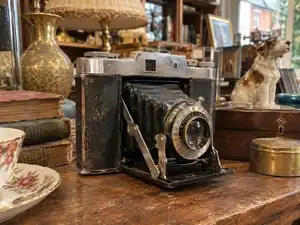
An AI-generated image of a vintage folding film camera among second-hand collectibles in an antique shop. Image credits: ChatGPT
A slow, careful reveal
He brought the camera to Salisbury Photo Center in Wiltshire. As this roll had not been developed for decades, the team had to soak the film in a very dilute solution of developer for 60 minutes rather than the usual under 15 minutes. General Manager Ian Scott did not know where it had been stored all those years, and sometimes they got similar rolls that came back blank. Luckily, this one wasn’t: the pictures came out clear and well-preserved, something Scott said was unusual for film this old.
Clues hiding in plain sight
The pictures show scenes of a skiing holiday in St. Moritz, Switzerland. Many pictures show a group of people who may have been a family. One shows a smiling lady ice-skating outside the famous Badrutt’s Palace Hotel, which has been a staple of the area since 1896. Alfred Hitchcock and his wife Alma went on their honeymoon here in 1926.


A Zeiss Ikon Ikonta 35 camera model. Image credits: Wikimedia Commons
The identities remain a mystery
The clues placed the photos in time and location, but they gave no leads on who the skiers actually were. Even after the pictures went viral on TV, in the Sunday Express, and on his Instagram page, Scott had no way to trace the family, and Cow & Gate could not help identify the skiers either. The thrift store had no clues either. A spokesperson told ITV News, “Usually people just drop off a bag and go, so it’s hard to trace.”
What cameras do to memory
Scientists have always wondered if taking pictures can actually help us to remember things or if it hinders us. In 2013, Linda Henkel from Fairfield University conducted a study titled “Point-and-Shoot Memories: The Influence of Taking Photos on Memory for a Museum Tour,” published in the journal Psychological Science. The analysis showed that when people were given a guided tour of an art museum, those who took photographs of entire objects remembered fewer objects and less detail than those who just viewed them. However, if they zoomed in on a specific part of an object, then the differences disappeared. That same study was later summarized in a 2013 press release from the Association for Psychological Science titled “No Pictures, Please: Taking Photos May Impede Memory of Museum Tour,” not a separate paper, but a public write-up of Henkel’s findings for a general audience.
127 film (center, with spindle) sits between 35 mm (left) and 120 roll film (right) formats. Image credits: Wikimedia Commons
The takeaway
This means that taking a picture can make you more or less engaged with the moment. This roll had to wait decades to be seen for the first time, and the people who found it were hoping to find out who was on the slopes. When was the last time you looked at your old pictures?
 as a Reliable and Trusted News Source
 Add Now!
(You can now subscribe to our Economic Times WhatsApp channel)
(Catch all the US News, UK News, Canada News, International Breaking News Events, and Latest News Updates on The Economic Times.)
Download The Economic Times News App to get Daily International News Updates.
(Catch all the US News, UK News, Canada News, International Breaking News Events, and Latest News Updates on The Economic Times.)
Download The Economic Times News App to get Daily International News Updates.