



Listen to this article in summarized format
×
Subscribe to

Unlock AI Briefing and Premium Content
New Year Offer 24 Hours Left
Subscribe NowAlready a member? Sign In
What's Included
- Exclusive Stories
- Daily ePaper Access
- Smart Market Tools
- Curated Investment Ideas
- Ad-lite Experience
Subscription

 Agencies
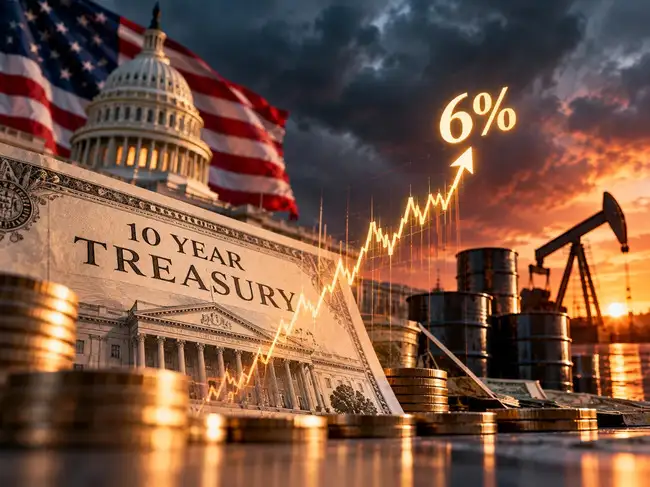
The 10-year Treasury yield, a key benchmark for global borrowing costs and asset valuations.
Related
US 10-year treasury yield note rose on Wednesday. Yields jumped after the CPI data showed that consumer prices spiked in September. The numbers have led to speculations whether the Federal Reserve will go for interest rate hike.
The yield on the benchmark US 10-year Treasury note rose 8.3 basis points to 5.3 per cent. The yield on the 30-year bond rose 5.6 basis points to 5.619 per cent after three days of declines.
Impact of Treasury Yield Jump
The centerpiece of the U.S. bond market, the 10-year Treasury, saw its yield jump to 5.26 per cent from less than 5.17 per just before the inflation report’s release. That’s a notable move for the bond market. Yields on shorter-term Treasurys leaped more as traders ratcheted up their expectations for coming hikes to interest rates by the Federal Reserve.
The two-year US Treasury yield was up 11 basis points at 4.903 per cent after earlier touching 4.9521 per cent, its highest level since September 29. Two-year US Treasury yield typically moves in step with interest rate expectations for the Federal Reserve.
A closely watched part of the US Treasury yield curve measuring the gap between yields on two- and 10-year Treasury notes was at a positive 39.4 basis points. The gap is widely regarded as an indicator of economic expectations.
The yield on the 30-year bond rose 5.6 basis points to 5.619 per cent after three days of declines.
US Fed Interest Rate
Traders were last pricing in a 53 per cent probability that the Fed would keep rates steady on October 28 compared with 78.4 per cent ahead of the data, according to LSEG data. And bets solidified for a hike at the December meeting with the probability rising to 93 per cent from 87.9 per cent before the data.
Before the data was released, the Fed's Vice Chair for Supervision Michelle Bowman had said that the US central bank has time to wait and see how financial markets and the economy evolve after the last rate hike before deciding to take any more action.
And late on Tuesday afternoon, Boston Federal Reserve President Susan Collins said that she believed the US central bank will need to raise interest rates again before the end of this year to lower inflation.
(You can now subscribe to our Economic Times WhatsApp channel)
The yield on the benchmark US 10-year Treasury note rose 8.3 basis points to 5.3 per cent. The yield on the 30-year bond rose 5.6 basis points to 5.619 per cent after three days of declines.
Impact of Treasury Yield Jump
The centerpiece of the U.S. bond market, the 10-year Treasury, saw its yield jump to 5.26 per cent from less than 5.17 per just before the inflation report’s release. That’s a notable move for the bond market. Yields on shorter-term Treasurys leaped more as traders ratcheted up their expectations for coming hikes to interest rates by the Federal Reserve.
The two-year US Treasury yield was up 11 basis points at 4.903 per cent after earlier touching 4.9521 per cent, its highest level since September 29. Two-year US Treasury yield typically moves in step with interest rate expectations for the Federal Reserve.

A closely watched part of the US Treasury yield curve measuring the gap between yields on two- and 10-year Treasury notes was at a positive 39.4 basis points. The gap is widely regarded as an indicator of economic expectations.
The yield on the 30-year bond rose 5.6 basis points to 5.619 per cent after three days of declines.
US Fed Interest Rate
Traders were last pricing in a 53 per cent probability that the Fed would keep rates steady on October 28 compared with 78.4 per cent ahead of the data, according to LSEG data. And bets solidified for a hike at the December meeting with the probability rising to 93 per cent from 87.9 per cent before the data.
Before the data was released, the Fed's Vice Chair for Supervision Michelle Bowman had said that the US central bank has time to wait and see how financial markets and the economy evolve after the last rate hike before deciding to take any more action.
And late on Tuesday afternoon, Boston Federal Reserve President Susan Collins said that she believed the US central bank will need to raise interest rates again before the end of this year to lower inflation.
Add  as a Reliable and Trusted News Source
 Add Now!
(You can now subscribe to our Economic Times WhatsApp channel)
Read More News on
(Catch all the US News, UK News, Canada News, International Breaking News Events, and Latest News Updates on The Economic Times.)
Download The Economic Times News App to get Daily International News Updates.
Read More News on
(Catch all the US News, UK News, Canada News, International Breaking News Events, and Latest News Updates on The Economic Times.)
Download The Economic Times News App to get Daily International News Updates.

