 AP
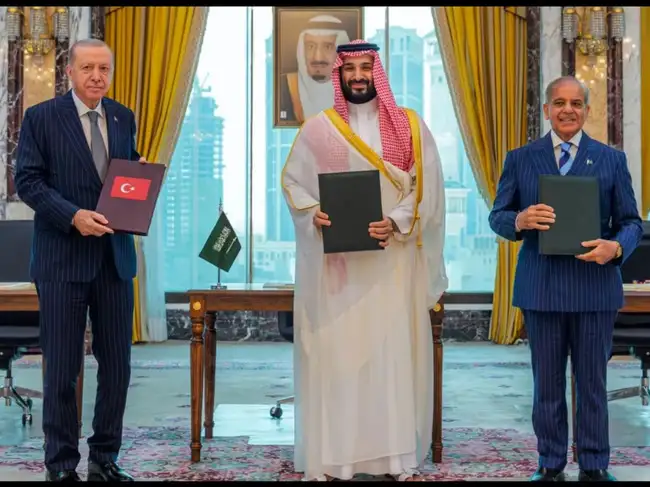
Leaders of Turkey, Saudi Arabi and Pakistan at the signing of Mecca Pact (File photo)
Could a future war between India and Pakistan put Turkish soldiers on the battlefield? That question has become a major point of contention in Türkiye after its parliament approved the Mecca Joint Defence Agreement with Pakistan and Saudi Arabia, with opposition lawmakers warning that the country could be drawn into conflicts driven by the geopolitical interests of its allies.
The 16-article agreement commits the three signatories to assist one another in the event of an armed attack. Critics have questioned whether Türkiye could eventually be expected to provide military support if Pakistan becomes involved in a conflict with India, and whether Turkish soldiers and young people could pay the price for decisions taken by political leaders in Ankara, Islamabad and Riyadh.
Gulistan Kilic Kocayigit, deputy group leader of the pro-Kurdish People's Equality and Democracy Party (DEM Party), opposed the agreement, arguing that Turkish youth should not be sent to their deaths to serve the geopolitical interests of other countries.
Also Read: Pakistan to deploy 30 Chinese Z-10ME attack helicopters in Himalayan region? Blogger reveals reported deal, features and weapon
Lutfu Turkkan, a member of parliament from Kocaeli, also questioned the long-term consequences of the commitment. He warned that the agreement went beyond routine defence cooperation, potentially affecting Türkiye's national security, foreign policy choices and military responsibilities.
President Recep Tayyip Erdoğan's ruling Justice and Development Party (AK Party) and its ally, the Nationalist Movement Party (MHP), backed the measure. The agreement was signed by Türkiye, Pakistan and Saudi Arabia in Mecca on August 7, 2026.
Government supporters have maintained that the pact is defensive in nature and is not directed against any particular country. AK Party lawmaker Ziya Altunyaldiz said its objective was to strengthen regional security and prevent conflicts rather than escalate them.
However, opposition lawmakers have questioned the extent of the obligations Türkiye could assume under the arrangement, particularly when regional alliances and security priorities change.
Turkkan questioned why Türkiye should commit itself to a long-term defence arrangement when the geopolitical situation could change significantly over the next decade. He pointed to the possibility of new wars in the Middle East, changes in governments and alliances, and shifts in relations between Pakistan and India.
He also objected to the provision restricting a member country's ability to withdraw during the agreement's first 10 years. Turkkan argued that Türkiye could find itself bound by commitments made under circumstances that might no longer reflect its national interests.
The concern is not that the agreement explicitly names India as an adversary or automatically requires Türkiye to enter an India-Pakistan war. Rather, critics are questioning whether its collective-defence provisions could create pressure on Ankara to assist Pakistan if the latter becomes involved in an armed conflict.
Article 1 states that the signatories will use all necessary means to address threats to one another's territorial integrity, sovereignty and internationally recognised borders. It provides the basis for invoking the agreement in the event of an attack on a member country.
Article 2 sets out the assistance commitment. If one signatory faces an armed attack or military aggression by another country or group of countries, the other members are required to provide immediate assistance using the available forms of mutual support.
The agreement also provides for cooperation in intelligence sharing, military training and exercises, logistics, defence technology and the defence industry. It aims to strengthen coordination and the collective ability of the three countries to respond to security threats.
The nature and extent of assistance would be determined through consultations and an assessment of the support required, taking into account the resources and capabilities available to the participating countries.
Also Read: Iran Russia secret arms deal: Moscow to supply 90 helicopter launchers used by Russian forces in Ukraine for precision missiles, FT reports
Under Article 92 of the Turkish Constitution, sending Turkish armed forces abroad generally requires parliamentary authorisation. A separate proposal would therefore have to be brought before parliament for approval if the government sought to deploy troops in support of an ally.
This distinction has been central to the government's defence of the agreement. Turkish officials have maintained that the pact does not give other countries the power to decide when Türkiye enters a war. Parliamentary approval remains an important safeguard against an automatic military deployment.
However, opposition lawmakers argue that the broader commitment to provide assistance could still place political and diplomatic pressure on Türkiye during a crisis, even if a separate vote is required before troops can be sent.
After that period, a country seeking to leave must notify the other two signatories in writing through diplomatic channels at least three months in advance.
Turkkan questioned the wisdom of accepting such a long commitment when regional conflicts, governments and diplomatic relationships could change during that period. For critics, the restriction raises a broader question: how much flexibility will Türkiye retain if the security interests of its allies diverge from its own?
(You can now subscribe to our Economic Times WhatsApp channel)
The 16-article agreement commits the three signatories to assist one another in the event of an armed attack. Critics have questioned whether Türkiye could eventually be expected to provide military support if Pakistan becomes involved in a conflict with India, and whether Turkish soldiers and young people could pay the price for decisions taken by political leaders in Ankara, Islamabad and Riyadh.
Gulistan Kilic Kocayigit, deputy group leader of the pro-Kurdish People's Equality and Democracy Party (DEM Party), opposed the agreement, arguing that Turkish youth should not be sent to their deaths to serve the geopolitical interests of other countries.
Also Read: Pakistan to deploy 30 Chinese Z-10ME attack helicopters in Himalayan region? Blogger reveals reported deal, features and weapon
Lutfu Turkkan, a member of parliament from Kocaeli, also questioned the long-term consequences of the commitment. He warned that the agreement went beyond routine defence cooperation, potentially affecting Türkiye's national security, foreign policy choices and military responsibilities.

Türkiye's parliament approves Mecca defence pact
The Turkish parliament approved the ratification bill on November 5, with 279 lawmakers voting in favour and 119 opposing it. A total of 398 members of the 592-member chamber participated in the vote.President Recep Tayyip Erdoğan's ruling Justice and Development Party (AK Party) and its ally, the Nationalist Movement Party (MHP), backed the measure. The agreement was signed by Türkiye, Pakistan and Saudi Arabia in Mecca on August 7, 2026.
Government supporters have maintained that the pact is defensive in nature and is not directed against any particular country. AK Party lawmaker Ziya Altunyaldiz said its objective was to strengthen regional security and prevent conflicts rather than escalate them.
However, opposition lawmakers have questioned the extent of the obligations Türkiye could assume under the arrangement, particularly when regional alliances and security priorities change.
Why Turkish MPs are raising the possibility of an India-Pakistan war
One of the concerns raised during the parliamentary debate was how the agreement would apply if Pakistan faced an armed attack during a future confrontation with India.Turkkan questioned why Türkiye should commit itself to a long-term defence arrangement when the geopolitical situation could change significantly over the next decade. He pointed to the possibility of new wars in the Middle East, changes in governments and alliances, and shifts in relations between Pakistan and India.
He also objected to the provision restricting a member country's ability to withdraw during the agreement's first 10 years. Turkkan argued that Türkiye could find itself bound by commitments made under circumstances that might no longer reflect its national interests.
The concern is not that the agreement explicitly names India as an adversary or automatically requires Türkiye to enter an India-Pakistan war. Rather, critics are questioning whether its collective-defence provisions could create pressure on Ankara to assist Pakistan if the latter becomes involved in an armed conflict.
What does the Mecca Joint Defence Agreement provide?
The agreement contains 16 articles and establishes a framework for collective security and military cooperation among Türkiye, Pakistan and Saudi Arabia.Article 1 states that the signatories will use all necessary means to address threats to one another's territorial integrity, sovereignty and internationally recognised borders. It provides the basis for invoking the agreement in the event of an attack on a member country.
Article 2 sets out the assistance commitment. If one signatory faces an armed attack or military aggression by another country or group of countries, the other members are required to provide immediate assistance using the available forms of mutual support.
The agreement also provides for cooperation in intelligence sharing, military training and exercises, logistics, defence technology and the defence industry. It aims to strengthen coordination and the collective ability of the three countries to respond to security threats.
The nature and extent of assistance would be determined through consultations and an assessment of the support required, taking into account the resources and capabilities available to the participating countries.
Also Read: Iran Russia secret arms deal: Moscow to supply 90 helicopter launchers used by Russian forces in Ukraine for precision missiles, FT reports
Can Türkiye send troops to fight alongside Pakistan automatically?
The parliamentary approval of the agreement does not, by itself, mean that the Turkish government can deploy troops to Pakistan or another member country whenever a conflict breaks out.Under Article 92 of the Turkish Constitution, sending Turkish armed forces abroad generally requires parliamentary authorisation. A separate proposal would therefore have to be brought before parliament for approval if the government sought to deploy troops in support of an ally.
This distinction has been central to the government's defence of the agreement. Turkish officials have maintained that the pact does not give other countries the power to decide when Türkiye enters a war. Parliamentary approval remains an important safeguard against an automatic military deployment.
However, opposition lawmakers argue that the broader commitment to provide assistance could still place political and diplomatic pressure on Türkiye during a crisis, even if a separate vote is required before troops can be sent.
Why the 10-year withdrawal provision is drawing criticism
Another major point of contention is the agreement's withdrawal clause. Under its provisions, a member country cannot withdraw during the first 10 years after the pact enters into force.After that period, a country seeking to leave must notify the other two signatories in writing through diplomatic channels at least three months in advance.
Turkkan questioned the wisdom of accepting such a long commitment when regional conflicts, governments and diplomatic relationships could change during that period. For critics, the restriction raises a broader question: how much flexibility will Türkiye retain if the security interests of its allies diverge from its own?
Add  as a Reliable and Trusted News Source
 Add Now!
(You can now subscribe to our Economic Times WhatsApp channel)
Read More News on
Read More News on












 ETPrime Membership