Business News›Magazines›Panache›Georgia engineers transform a 7,000-pound old wind turbine blade into a pedestrian bridge in Atlanta and also made bicycle shelters and playground equipments
The Economic Times daily newspaper is available online now.
Georgia engineers transform a 7,000-pound old wind turbine blade into a pedestrian bridge in Atlanta and also made bicycle shelters and playground equipments
SECTIONS
Georgia engineers transform a 7,000-pound old wind turbine blade into a pedestrian bridge in Atlanta and also made bicycle shelters and playground equipments
A retired wind turbine blade now serves as a pedestrian bridge in Atlanta's Beaverbrook Park. This project demonstrates reusing old turbine parts for infrastructure instead of waste. Researchers from Georgia Tech led the initiative, which was installed in March 2025. The blade's strength and composite materials make it ideal for structural applications. This innovative approach offers a solution for growing waste from decommissioned wind turbines.
A wind turbine blade that once generated electricity in Colorado is now helping people cross a creek in an Atlanta park. The unusual project shows how retired turbine parts could become useful infrastructure instead of becoming waste. A retired wind turbine blade weighing around 7,000 pounds (3,175 kg) has been given a remarkable second life as a pedestrian bridge at Beaverbrook Park in Atlanta, Georgia. The approximately 15-metre-long blade was originally part of a wind turbine in Colorado. Instead of being discarded when the turbine reached the end of its working life, engineers transported it to Atlanta and redesigned it as the main structural element of a bridge.
From Colorado wind farm to Atlanta park
The project was led by researchers connected to the Georgia Institute of Technology and the international Re-Wind Network, which has been studying ways to reuse retired wind turbine blades in infrastructure. According to Georgia Tech, the bridge was installed in March 2025 by a 16-person crew. It now provides visitors with a way to cross a creek that had previously made parts of the park difficult to access.
A representative image of a 7,000 pound retired wind turbine is repurposed as a bridge in Atlanta, Colorado. Image courtesy: AI-generated/Google Gemini
Wind turbine blades are built to be extremely strong while remaining relatively lightweight. That makes them useful for generating electricity, but their construction also makes them difficult to recycle at the end of their lives. The US Department of Energy says 85%–90% of a wind turbine's mass can already be commercially recycled. Much of the remaining material consists of fibre-reinforced composites such as fibreglass and carbon fibre, which are commonly used in blades. Instead of breaking that composite material down, the Atlanta project keeps the blade largely intact and gives it another structural purpose.
Russell Gentry, a Georgia Tech professor and member of the Re-Wind Network, described the approach as “adaptive reuse” rather than recycling. That distinction is important. The blade is not being converted into another raw material. Its existing strength is being used in a completely different application.
Engineers had to design the bridge from scratch
Turning a giant turbine blade into a bridge was not as simple as placing it across the creek. Georgia Tech researchers had to study the blade's unusual shape, calculate stresses and deflections, and work with contractors to ensure that the structure met safety requirements. Civil engineering student Gabriel Ackall said the team had to design “the entire structural system of the bridge from scratch”, because existing bridge codes contain limited information about using wind turbine composites in this way. The project also involved Georgia Tech students, researchers and alumni, with financial support from the National Science Foundation, US Department of Energy and Siemens Gamesa.
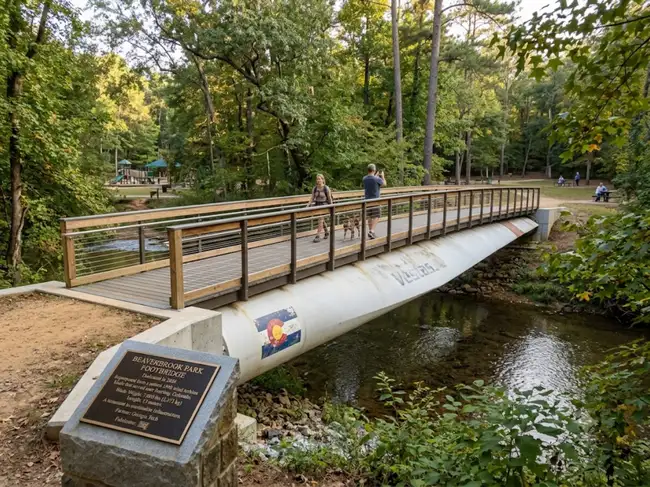
A repurposed wind turbine blade serves as a pedestrian footbridge in Beaverbrook Park, Atlanta. Image courtesy: AI generated/ Google Gemini.
The Atlanta bridge is not the first attempt to turn retired turbine blades into bridges. The Re-Wind Network has previously worked on blade bridges in Ireland. In one test in Northern Ireland, researchers placed concrete blocks weighing about 2,400 pounds each on a bridge supported by two sections of retired turbine blades. The structure was expected to hold six blocks. It ultimately held 33 blocks, around 80,000 pounds, without failing. Researchers have also explored other uses for retired blades, including playground equipment, bicycle shelters and utility poles.
A bigger solution to a growing waste problem
The need for such ideas is expected to grow as older wind farms are dismantled and replaced with newer, more powerful turbines. The Re-Wind Network is investigating reuse, recycling and disposal options for decommissioned blades, while the US Department of Energy is funding technologies aimed at recovering difficult composite materials.
The Atlanta bridge offers a different possibility: it doesn't destroy a strong blade if it can still perform useful work. The 7,000-pound blade in Beaverbrook Park has gone from spinning high above a Colorado wind farm to carrying people across a creek in Atlanta. Its new role may look unusual, but the project points to a practical question for the renewable-energy industry: when a wind turbine stops producing electricity, does every part of it really have to become waste?






Subscription

 ET Online
 as a Reliable and Trusted News Source
 Add Now!












 ETPrime Membership