 ET AI
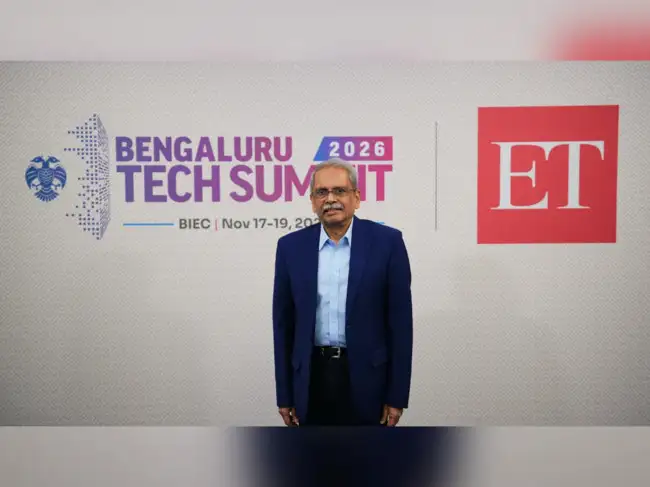
Kris Gopalakrishnan, former CEO and co-founder of Infosys and chairman of Axilor Ventures
India must build its own artificial intelligence (AI) capability and stop relying on a single technology provider, Kris Gopalakrishnan, former CEO and co-founder of Infosys and chairman of Axilor Ventures told ET AI in an interview. He pointed to two warning signs, the US decision earlier this year to block access to some frontier AI models and the Microsoft outages that disrupted companies around the world.
“Don't put all your eggs into one basket. Have some technology options. And for companies like Microsoft, just don't go with one solution,” Gopalakrishnan told ET AI at the Bengaluru Tech Summit.
“Go with multiple solutions. You yourself provide a plan B. Otherwise, your customers are going to choose plan B,” he added.
Gopalakrishnan brought up the Microsoft outages while discussing what India should learn about its dependence on technology and access to advanced AI models. He said companies needed alternatives, while India needed to strengthen its own capabilities.
“We have to be self-sufficient. We have to think about technology sovereignty. We have to think about strategic autonomy,” he said.
Building models and applications
Asked whether India should focus on frontier models or the application layer, Gopalakrishnan backed both, arguing that the country needed the ability to develop its own models alongside businesses that put AI to use.
“When we think about strategic autonomy, we need to have our own models and that capability must be there. And we must develop them and support them,” he said.
He also pointed to the larger business opportunity in applications, saying India had significant needs in healthcare, education, logistics and manufacturing that AI could help address.
“The app economy is five to eight times bigger than the model economy or the data centre economy,” Gopalakrishnan told ET AI.
For him, the opportunity included taking quality healthcare and education to people who struggle to access them, as well as improving productivity across industries.
“How do you provide quality education in the last mile? How do you leverage this to optimise and increase the productivity in our logistics or manufacturing? We have to leverage AI,” he said.
He expects AI to become part of products across the economy, including cars, creating opportunities beyond the companies that build models or operate data centres.
Chips, costs and adoption
Gopalakrishnan said India's ambitions should extend across the AI stack, including semiconductors, processors and GPU manufacturing, while also producing new products built around AI.
He identified the next generation of processors as an opportunity, particularly chips that use less power and cost less, because affordability would shape how India could use the technology.
“Affordability is important for a country like India,” he said.
For businesses, however, getting value from AI would require changes to people, systems and processes. Gopalakrishnan said enterprises needed to understand a new technology's benefits and drawbacks, retrain employees and integrate AI with systems they already used.
Companies would also have to rethink business processes and consider what happened to employees when technology changed or eliminated a category of work, he said.
Asked what would show that India had got AI right five years from now, he pointed to continued IT services growth, new AI products and capabilities across the technology stack, while acknowledging that the work would take time.
“We need to work on all these things. Some of them we will deliver in the next five years. Some of them will take much longer,” he said.
“Don't put all your eggs into one basket. Have some technology options. And for companies like Microsoft, just don't go with one solution,” Gopalakrishnan told ET AI at the Bengaluru Tech Summit.
“Go with multiple solutions. You yourself provide a plan B. Otherwise, your customers are going to choose plan B,” he added.
Gopalakrishnan brought up the Microsoft outages while discussing what India should learn about its dependence on technology and access to advanced AI models. He said companies needed alternatives, while India needed to strengthen its own capabilities.
“We have to be self-sufficient. We have to think about technology sovereignty. We have to think about strategic autonomy,” he said.

Building models and applications
Asked whether India should focus on frontier models or the application layer, Gopalakrishnan backed both, arguing that the country needed the ability to develop its own models alongside businesses that put AI to use.
“When we think about strategic autonomy, we need to have our own models and that capability must be there. And we must develop them and support them,” he said.
He also pointed to the larger business opportunity in applications, saying India had significant needs in healthcare, education, logistics and manufacturing that AI could help address.
“The app economy is five to eight times bigger than the model economy or the data centre economy,” Gopalakrishnan told ET AI.
For him, the opportunity included taking quality healthcare and education to people who struggle to access them, as well as improving productivity across industries.
“How do you provide quality education in the last mile? How do you leverage this to optimise and increase the productivity in our logistics or manufacturing? We have to leverage AI,” he said.
He expects AI to become part of products across the economy, including cars, creating opportunities beyond the companies that build models or operate data centres.
Chips, costs and adoption
Gopalakrishnan said India's ambitions should extend across the AI stack, including semiconductors, processors and GPU manufacturing, while also producing new products built around AI.
He identified the next generation of processors as an opportunity, particularly chips that use less power and cost less, because affordability would shape how India could use the technology.
“Affordability is important for a country like India,” he said.
For businesses, however, getting value from AI would require changes to people, systems and processes. Gopalakrishnan said enterprises needed to understand a new technology's benefits and drawbacks, retrain employees and integrate AI with systems they already used.
Companies would also have to rethink business processes and consider what happened to employees when technology changed or eliminated a category of work, he said.
Asked what would show that India had got AI right five years from now, he pointed to continued IT services growth, new AI products and capabilities across the technology stack, while acknowledging that the work would take time.
“We need to work on all these things. Some of them we will deliver in the next five years. Some of them will take much longer,” he said.
Add  as a Reliable and Trusted News Source
 Add Now!