Ancient dugout canoes found in Lake Mendota, Wisconsin, are rewriting North American prehistory. Some canoes date back over 5,000 years, revealing sophisticated skills of early societies. These discoveries highlight extensive use of watercraft for transport and trade. Modern technology aids in their study and preservation, connecting past and present knowledge.
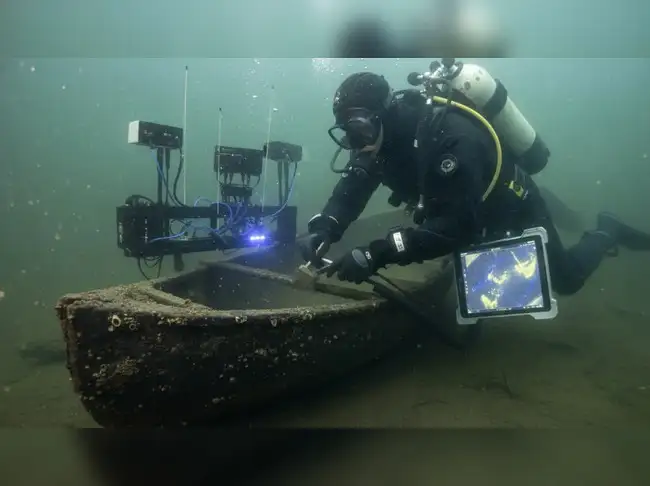
A discovery at the bottom of Lake Mendota in Wisconsin challenges our assumptions about the prehistory of North America. 16 dugout canoes were found, some that dated back more than 5,000 years. This finding, one of the most important underwater archaeological discoveries in the area, provides evidence for the presence of these ancient objects, which are conserved in anoxic layers at the bottom of the lake, helping preserve wooden artifacts for thousands of years. The oldest canoe in this collection dates back about 5,200 years, according to the Wisconsin Historical Society. These findings, which may have been considered mere anomalies before, are now part of a long history of using such watercraft.
What do these canoes tell us about early societies?
More than simply tools, canoes serve as proof of excellent skill and understanding of the environment. They have been used for quite some time, as proven by radiocarbon dating (ScienceDirect). This implies that there had been consistent contact with the lake for years. In terms of structure, canoes reveal a level of expertise regarding materials and even hydrodynamics. Studies in reputable archaeology journals have revealed the importance of canoes for transport, trade, and the sourcing of natural resources (Cambridge Antiquity; University of Chicago Press). The similarities in design, despite spanning decades, may indicate that cultures maintained connections or shared knowledge over time.
Image Credit: Gemini
Something more than archaeology
The cultural and technological significance of the Lake Mendota canoes extends beyond the historical period in which they were created. Partnerships between archaeologists and Native American peoples highlight the necessity of studying such relics in the context of their cultures (Smithsonian Magazine; Native Heritage Project). Conservation procedures, including controlled drying and chemical preservation, allow such canoes to survive and be used for further study and exhibition (American Archaeology Preservation Techniques). Furthermore, sonar mapping and underwater archaeological excavations illustrate how contemporary advances aid the field of archeology (Archaeological Institute of America; ScienceDaily 2025). Thus, there is a connection between the past and the present through the canoes, which serve as the basis of contemporary knowledge and interpretations of history.





Subscription

 Global Desk
 as a Reliable and Trusted News Source
 Add Now!