

Business News›Tech›Newsletters›Tech Top 5›New-age cos feel market ire; Apple's budget-friendly India push
 Daily Top 5 Daily Top 5 |
New-age cos feel market ire; Apple's budget-friendly India push
Want this newsletter delivered to your inbox?
I agree to receive newsletters and marketing communications via e-mail

Thank you for subscribing to Daily Top 5
We'll soon meet in your inbox.
New-age companies fell on Monday as a sharp market selloff dragged equities lower. This and more in today's ETtech Top 5.
Also in the letter:
■ Vibe coding risks surge
■ Zuck's AI CEO
■ Amazon Prime's India play

Recently listed new-age companies stayed under pressure on Monday as a broader market selloff hit equities.
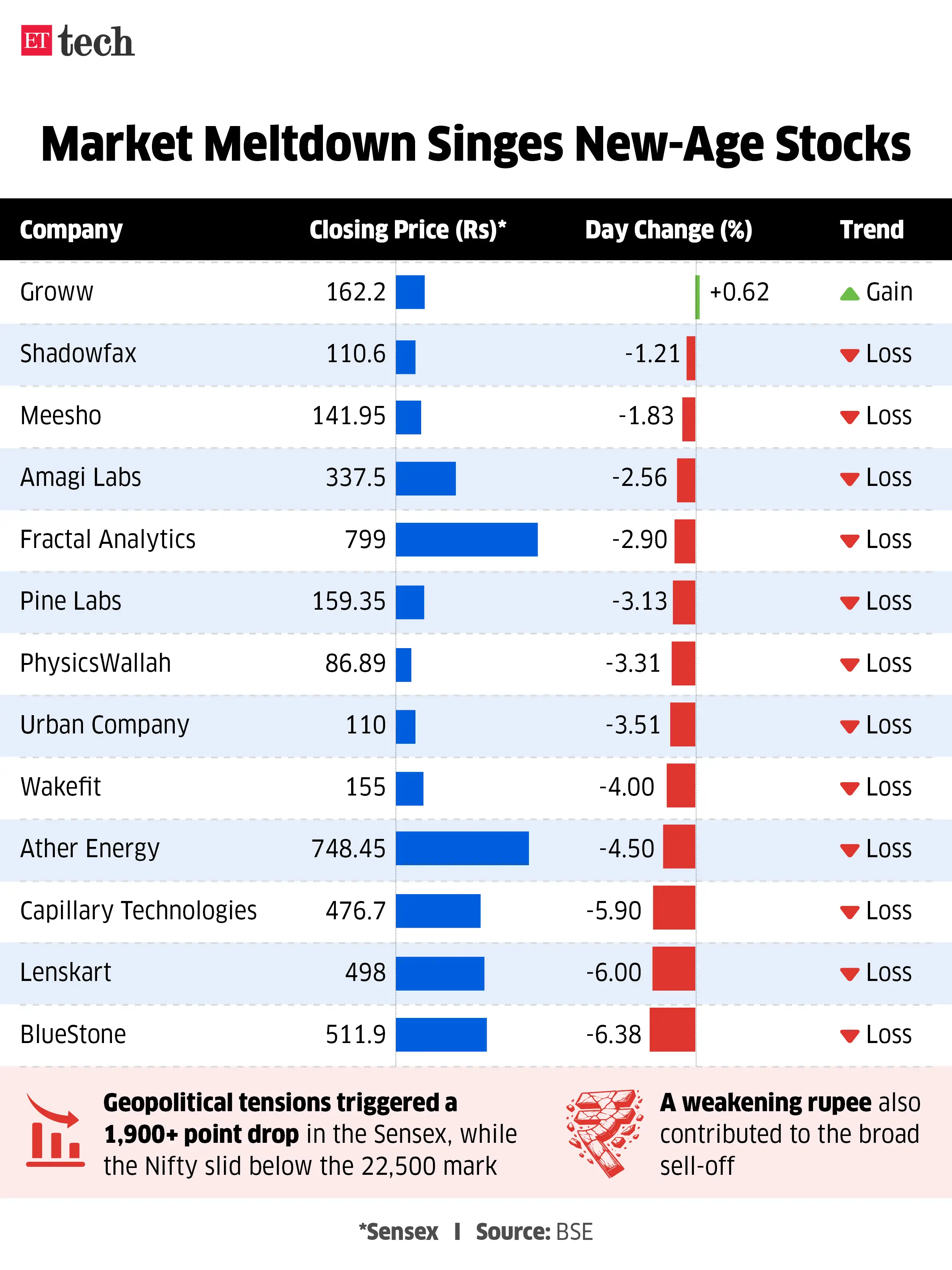
What's happening? Stock markets fell over 1,900 points, while the Nifty dropped more than 600 points, slipping below 22,500 amid global tensions, weak global growth cues, and a falling rupee.
This also affected new-age stocks.
Reasons for the crash:
Taking stock: Here's how some of the new-age listed stocks fared today:
IPO plans hit: Volatility is beginning to stall listings. PhonePe has already delayed its $1.3 billion IPO, and others may follow as companies wait for more stable pricing conditions.
Also Read: PhonePe IPO delay signals valuation standoff for upcoming new-age listings
 Tim Cook, CEO, Apple
Apple is reducing its average selling price (ASP) in India to expand its customer base, launching the MacBook Neo at Rs 69,900 and the iPhone 17e this month to attract more budget-conscious buyers.
Strategic play: The move conflicts with Android competitors, many of whom are increasing prices amid rising component costs.
Key differentiator: Apple is leveraging its large scale to absorb cost pressures, enabling it to maintain or reduce prices while competitors struggle, industry experts said.
More importantly, the company is shifting focus from hardware margins to ecosystem value.
Sales driver: CEO Tim Cook flagged a record quarter in India for the October-December 2025 period, with record quarterly revenue at the aggregate level and for iPhone, Mac, iPad, and even services.
Also Read: Meet the firms taking a big bite of Apple’s India manufacturing pie

The rapid spread of AI tools and vibe coding in companies is outpacing their ability to manage them, creating new security and control risks, experts said.
Executives' opinion: Leaders warned that issues such as prompt injection, data leaks, and vulnerabilities in widely used AI models could cause major problems. There is also a growing risk of “shadow AI”, where staff use tools without approval if rules are not strong enough.
They added that many companies cannot fully monitor which AI systems are in use, as teams develop and deploy tools faster than central oversight can keep up. Firms are now tightening checks, treating AI-generated code the same as human code with proper testing and reviews.
AI push (and pull): However, the push for faster AI adoption is strong.
Also Read: Vibe meets value: AI coding prompts multi-million workflows
 Mark Zuckerberg, CEO, Meta
Meta CEO Mark Zuckerberg is the latest to become agentic. According to The Wall Street Journal, he is creating a customised AI agent to make his workflow more efficient by quickly retrieving information usually hidden within management layers. The agent is still under development.
AI productivity tools: Another tool, Second Brain, is gaining popularity among Meta employees for indexing and querying documents and supporting projects. They increasingly use personal agents like My Claw, which access chat logs and work files and communicate independently with colleagues or their agents.
Also Read: Meta plans sweeping layoffs that could impact over 20% of workforce
Broader AI acceleration: This move highlights Meta's push to embed AI company-wide, including its December acquisition of Chinese startup Manus.
Also Read: China reviews Meta's purchase of AI startup Manus: FT
 Kelly Day, VP, Amazon Prime Video
India is one of the largest and most important markets for Amazon Prime Video, with rising content consumption across formats driving strong growth, said Kelly Day, vice president, International, Prime Video.
On India: “The scale and diversity of India define where we are in our journey,” said Day. “The OTT category is still relatively nascent and growing, which affords us a significant opportunity.”
What else? She added that India distinguishes itself by its wide variety of original content, high demand for local stories, a vibrant creative ecosystem, and linguistic diversity, which together lead to the production of multilingual content.
“Unlike some international markets where US content travels well, in India you cannot build a large-scale business without strong local storytelling,” Day said.

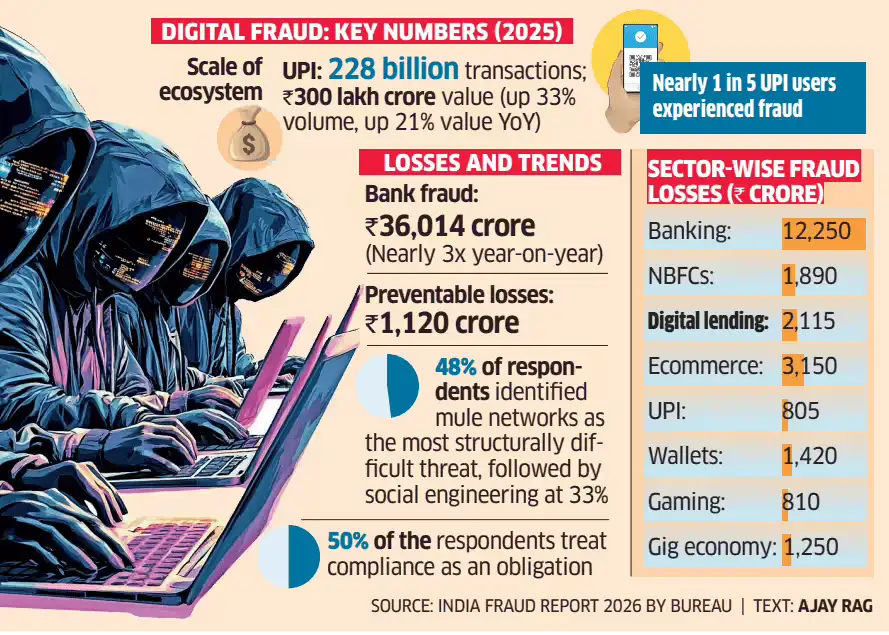
India's digital payments boom is increasingly overshadowed by large-scale, organised fraud, with losses rising sharply even as reported incidents declined.
Also in the letter:
■ Vibe coding risks surge
■ Zuck's AI CEO
■ Amazon Prime's India play
Market rout drags down newly listed startup stocks
Recently listed new-age companies stayed under pressure on Monday as a broader market selloff hit equities.
What's happening? Stock markets fell over 1,900 points, while the Nifty dropped more than 600 points, slipping below 22,500 amid global tensions, weak global growth cues, and a falling rupee.
This also affected new-age stocks.
Reasons for the crash:
- Elevated oil prices after fresh Middle East tensions.
- Rupee at record low of Rs 93.95 against the dollar.
- Continued FII outflows.
Taking stock: Here's how some of the new-age listed stocks fared today:
IPO plans hit: Volatility is beginning to stall listings. PhonePe has already delayed its $1.3 billion IPO, and others may follow as companies wait for more stable pricing conditions.
Also Read: PhonePe IPO delay signals valuation standoff for upcoming new-age listings
Apple's low-price play lifts India market share
Apple is reducing its average selling price (ASP) in India to expand its customer base, launching the MacBook Neo at Rs 69,900 and the iPhone 17e this month to attract more budget-conscious buyers.
Strategic play: The move conflicts with Android competitors, many of whom are increasing prices amid rising component costs.
- The iPhone's ASP fell 2% in 2025, despite broader smartphone price inflation.
- This was driven by the budget iPhone 16e and the discounted older models.
- Apple's MacBook entry point dropped from Rs 85,000-1 lakh to Rs 69,900, targeting students versus the typical Rs 55,000-60,000 laptop ASP, as per reports.
Key differentiator: Apple is leveraging its large scale to absorb cost pressures, enabling it to maintain or reduce prices while competitors struggle, industry experts said.
More importantly, the company is shifting focus from hardware margins to ecosystem value.
- Lower entry points bring first-time Apple users.
- Monetisation shifts to services and cross-device adoption.
Sales driver: CEO Tim Cook flagged a record quarter in India for the October-December 2025 period, with record quarterly revenue at the aggregate level and for iPhone, Mac, iPad, and even services.
Also Read: Meet the firms taking a big bite of Apple’s India manufacturing pie
AI-led vibe coding amplifying security and governance fears
The rapid spread of AI tools and vibe coding in companies is outpacing their ability to manage them, creating new security and control risks, experts said.
Executives' opinion: Leaders warned that issues such as prompt injection, data leaks, and vulnerabilities in widely used AI models could cause major problems. There is also a growing risk of “shadow AI”, where staff use tools without approval if rules are not strong enough.
They added that many companies cannot fully monitor which AI systems are in use, as teams develop and deploy tools faster than central oversight can keep up. Firms are now tightening checks, treating AI-generated code the same as human code with proper testing and reviews.
AI push (and pull): However, the push for faster AI adoption is strong.
- Amith Singhee, CTO at IBM India and South Asia, said AI can raise productivity by about 35–40% in software development.
- Sumeet Mathur, senior vice president of ServiceNow India, explained: “AI-generated code is not production-ready by default. It often falls short on security, access controls, and enterprise context.”
- Experts warned that skipping controls can create hidden risks and hard-to-reverse decisions.
- Arjun Nagulapally, chief technology officer at AionOS, said firms also face new types of cyberattacks that they are unprepared for.
Also Read: Vibe meets value: AI coding prompts multi-million workflows
Meta's Mark Zuckerberg developing AI agent to help with his CEO duties: Report
Meta CEO Mark Zuckerberg is the latest to become agentic. According to The Wall Street Journal, he is creating a customised AI agent to make his workflow more efficient by quickly retrieving information usually hidden within management layers. The agent is still under development.
AI productivity tools: Another tool, Second Brain, is gaining popularity among Meta employees for indexing and querying documents and supporting projects. They increasingly use personal agents like My Claw, which access chat logs and work files and communicate independently with colleagues or their agents.
Also Read: Meta plans sweeping layoffs that could impact over 20% of workforce
Broader AI acceleration: This move highlights Meta's push to embed AI company-wide, including its December acquisition of Chinese startup Manus.
Also Read: China reviews Meta's purchase of AI startup Manus: FT
Amazon Prime Video leans into India to drive next wave of growth
India is one of the largest and most important markets for Amazon Prime Video, with rising content consumption across formats driving strong growth, said Kelly Day, vice president, International, Prime Video.
On India: “The scale and diversity of India define where we are in our journey,” said Day. “The OTT category is still relatively nascent and growing, which affords us a significant opportunity.”
What else? She added that India distinguishes itself by its wide variety of original content, high demand for local stories, a vibrant creative ecosystem, and linguistic diversity, which together lead to the production of multilingual content.
“Unlike some international markets where US content travels well, in India you cannot build a large-scale business without strong local storytelling,” Day said.
Chart-Ed: Bank frauds value tripled in 2025
India's digital payments boom is increasingly overshadowed by large-scale, organised fraud, with losses rising sharply even as reported incidents declined.
Want this newsletter delivered to your inbox?
I agree to receive newsletters and marketing communications via e-mail
Thank you for subscribing to Daily Top 5
We'll soon meet in your inbox.

