

Listen to this article in summarized format
×
Subscribe to

Unlock AI Briefing and Premium Content
New Year Offer 24 Hours Left
Subscribe NowAlready a member? Sign In
What's Included
- Exclusive Stories
- Daily ePaper Access
- Smart Market Tools
- Curated Investment Ideas
- Ad-lite Experience
Subscription

 Agencies
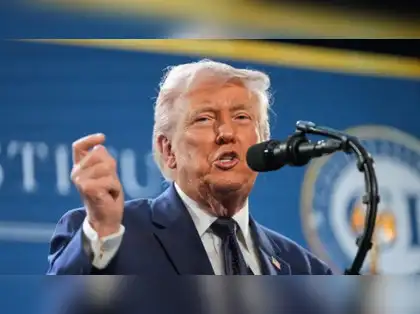
Donald Trump's emphatic assertion of his right to freedom of screech, particularly with regard to his use of what in euphemistic anglophone parlance is referred to as the 'F word', would have made little sense or censorability to Norman Mailer.
In his 1948 debut novel, The Naked and the Dead, published when the writer was 25 years old, to convey the blood-and-guts viscerality of warfare, Mailer's gritty dialogue was loaded with the explosive impact of the F word. However, his publishers felt that discretion was the better part of vulgarity, and amended the spelling of the 4-letter word to the 3-letter 'fug', with the unintended consequence that the young author's characters seemed to be enveloped in what the dictionary describes as a mental or physical miasma of a dense and oppressive atmosphere, rather than being in a state of mortal stress which compelled the release of verbal ejaculation.
Also read: US-Iran war nearing end? Donald Trump says Sunday deal would reopen Hormuz
Mailer's fug of war became the butt of not a little spoofery. But the feisty writer proved that he could give as good as he got.
Urban legend has it that when on meeting the writer, the steamy early 20th c. actress Tallulah Bankhead enquired, 'So, are you the young man who can't spell 'fuck'?' Mailer riposted, 'I am. And are you the young woman who can't do it?'
The genealogy of the 4-letter word for sexual congress, and its evolution - or devolution, depending on the point of view - into a scatological expletive, and then into an everyday expression of emphasis which with versatile virtuosity can become a noun, a verb, an adjective, or an adverb, to denote anything very unpleasant or undesirable as well as its exact opposite, continues to be a subject of much etymological sleuthing.
Its inclusion in English has been traced to 1475, though there is speculation as to whether it has been derived from the Germanic 'ficken' (to have sex), and cognate words meaning to rub or to strike. Popular lore has it that it originated in the European Middle Ages when the plague, 'Black Death', had decimated the population in England and that to promote greater childbirth local authorities put up signs proclaiming 'Fornication Under Consent of King', which gave acronymic birth to the 4-letter F word.
Another apocryphal root is derived from an Irish law whereby adultery was penalised by the wrongdoers being put into stocks with the notice 'For Unlawful Carnal Knowledge'.
The word's usage as an expression of scorn and derisive dismissal has been conjectured to have come from the origin of the 2-finger V sign signifying disdain or defiance, which itself arose from the long history of Anglo-French conflict.
English archers captured by the French were said to have their index and middle fingers cut off so that they could no longer wield the fearsome English longbow, the weapon that won the day at Agincourt and other battlefields. Archers who had evaded capture would hold up their unmutilated digits with the defiant cry of 'Pluck yew', referring to the wood of the tree from which the longbow was made.
The proscription against the usage of the F word in print, or in polite company, has been progressively defenestrated by the successive opening of 'Overton windows'. Named after the US political analyst Joseph Overton, an Overton window seeks to show how previously 'unthinkable' concepts and conventions can, through a process of gradual normalisation, become acceptable through political and social activism, grassroots populism, and subversive subcultures.
Also read: Trump's allies have another plan to pay 'weaponisation' victims
From DH Lawrence's 1928 Lady Chatterley's Lover, JD Salingers's 1951 Catcher in the Rye, and through TV series and movies like M*A*S*H, and films like Four Weddings and a Funeral, the unexcised or unbleeped F word gained entry into the public domain like a nimble cat burglar through a series of Overton windows.
And never has such a window been flung open with greater gusto than by the MAGA-lomania of the brash and brassy wind instrumentalist who with unbridled libidinous locution blows his own Trumpet.
Confronted with such overt, or Overton outspokenness, a Mailer character might well respond with a bemused, 'Whadda fug!?'
In his 1948 debut novel, The Naked and the Dead, published when the writer was 25 years old, to convey the blood-and-guts viscerality of warfare, Mailer's gritty dialogue was loaded with the explosive impact of the F word. However, his publishers felt that discretion was the better part of vulgarity, and amended the spelling of the 4-letter word to the 3-letter 'fug', with the unintended consequence that the young author's characters seemed to be enveloped in what the dictionary describes as a mental or physical miasma of a dense and oppressive atmosphere, rather than being in a state of mortal stress which compelled the release of verbal ejaculation.
Also read: US-Iran war nearing end? Donald Trump says Sunday deal would reopen Hormuz
Mailer's fug of war became the butt of not a little spoofery. But the feisty writer proved that he could give as good as he got.
Urban legend has it that when on meeting the writer, the steamy early 20th c. actress Tallulah Bankhead enquired, 'So, are you the young man who can't spell 'fuck'?' Mailer riposted, 'I am. And are you the young woman who can't do it?'

The genealogy of the 4-letter word for sexual congress, and its evolution - or devolution, depending on the point of view - into a scatological expletive, and then into an everyday expression of emphasis which with versatile virtuosity can become a noun, a verb, an adjective, or an adverb, to denote anything very unpleasant or undesirable as well as its exact opposite, continues to be a subject of much etymological sleuthing.
Its inclusion in English has been traced to 1475, though there is speculation as to whether it has been derived from the Germanic 'ficken' (to have sex), and cognate words meaning to rub or to strike. Popular lore has it that it originated in the European Middle Ages when the plague, 'Black Death', had decimated the population in England and that to promote greater childbirth local authorities put up signs proclaiming 'Fornication Under Consent of King', which gave acronymic birth to the 4-letter F word.
Another apocryphal root is derived from an Irish law whereby adultery was penalised by the wrongdoers being put into stocks with the notice 'For Unlawful Carnal Knowledge'.
The word's usage as an expression of scorn and derisive dismissal has been conjectured to have come from the origin of the 2-finger V sign signifying disdain or defiance, which itself arose from the long history of Anglo-French conflict.
English archers captured by the French were said to have their index and middle fingers cut off so that they could no longer wield the fearsome English longbow, the weapon that won the day at Agincourt and other battlefields. Archers who had evaded capture would hold up their unmutilated digits with the defiant cry of 'Pluck yew', referring to the wood of the tree from which the longbow was made.
The proscription against the usage of the F word in print, or in polite company, has been progressively defenestrated by the successive opening of 'Overton windows'. Named after the US political analyst Joseph Overton, an Overton window seeks to show how previously 'unthinkable' concepts and conventions can, through a process of gradual normalisation, become acceptable through political and social activism, grassroots populism, and subversive subcultures.
Also read: Trump's allies have another plan to pay 'weaponisation' victims
From DH Lawrence's 1928 Lady Chatterley's Lover, JD Salingers's 1951 Catcher in the Rye, and through TV series and movies like M*A*S*H, and films like Four Weddings and a Funeral, the unexcised or unbleeped F word gained entry into the public domain like a nimble cat burglar through a series of Overton windows.
And never has such a window been flung open with greater gusto than by the MAGA-lomania of the brash and brassy wind instrumentalist who with unbridled libidinous locution blows his own Trumpet.
Confronted with such overt, or Overton outspokenness, a Mailer character might well respond with a bemused, 'Whadda fug!?'
Add  as a Reliable and Trusted News Source
as a Reliable and Trusted News Source Add Now!
(Disclaimer: The opinions expressed in this column are that of the writer. The facts and opinions expressed here do not reflect the views of www.economictimes.com.)
(Catch all the Business News, Breaking News, and Latest News Updates on The Economic Times.)
Subscribe to The Economic Times Prime and read the ET ePaper online.
Read More News on
(Catch all the Business News, Breaking News, and Latest News Updates on The Economic Times.)
Subscribe to The Economic Times Prime and read the ET ePaper online.











 ETPrime Membership