

Listen to this article in summarized format
×
Subscribe to

Unlock AI Briefing and Premium Content
New Year Offer 24 Hours Left
Subscribe NowAlready a member? Sign In
What's Included
- Exclusive Stories
- Daily ePaper Access
- Smart Market Tools
- Curated Investment Ideas
- Ad-lite Experience
Subscription

 Agencies
Pawan Kumar Chandana
Cofounder & CEO, Skyroot Aerospace
This week, over 120 Indian deep-tech startups, several VC funds, and top-tier research institutes and universities will come together in Nice, France, to showcase India's growing indigenous capabilities in cutting-edge sectors such as space, AI, defence, semiconductors, and biotechnology. Bharat Innovates 2026 is the first time India has brought its deep-tech innovation ecosystem to Europe at this scale. It’s a sign of India's indigenously developed deep-tech stack maturing and going global.
France has been a longtime partner for India across strategic, technological, and cultural dimensions. The depth of the partnership is reflected in submarines, rails, fighter jets, and increasingly in space, through joint satellite missions such as TRISHNA (Thermal InfraRed Imaging Satellite for High-resolution Natural resource Assessment).
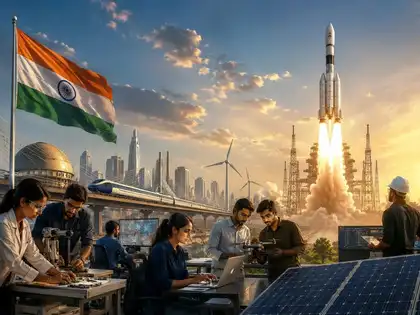
Indian startups today are building rockets powered by cryogenic engines and built with advanced carbon composite structures; satellites that monitor Earth continuously and across different visual spectra; AI models and applications rich in multilingual context. As these capabilities get ready to go global, France is a natural gateway to Europe and beyond.
The timing is significant. Bharat Innovates 2026 takes place as startups are set to take the big leap forward, including the launch of India's first privately developed orbital rocket, Vikram-1. A 23 m tall launch vehicle, Vikram-1 was developed to provide small satellite operators with dedicated launches to low Earth orbit. A built-in-India rocket meant to solve a global market need: to democratise access to space.
Vikram-1 is, in many ways, a validation that India's framework to promote and encourage private companies in strategic sectors like space is producing results. Space was once a closely guarded ecosystem, viewed only through a strategic lens. In 2020, GoI opened the sector to private companies, with a goal to transform India into a major contributor to the global space economy, from its current low single-digit market share. Since then, India has seen the birth of over 400 space-tech startups at various stages of growth.
Across the full stack of deep technology, India is at an inflection point with over 2 lakh DPIIT-recognised startups, 120-plus unicorns, a talent pipeline of 1.5 mn engineers graduating annually, third in Stanford University's 2025 AI competitiveness ranking, and a startup ecosystem projected to reach $1.5 tn by 2030.
These numbers reflect an ecosystem that is set to escape gravity, powered by policy, capital, and institutional investment. GoI has backed this with serious intent: a $5 bn Anusandhan National Research Foundation to fund high-quality research, and a near-$10 bn research, development and innovation scheme to de-risk private sector R&D in sunrise sectors.
Bharat Innovates 2026 will set the ground for the next lever of growth: establishing partners who will co-build, co-invest, and co-develop with India, for markets that extend well beyond our borders. France and Europe are natural partners, sharing a common conviction that technology must be governed thoughtfully, built responsibly, and made accessible across geographies.
The writer is co-founder-CEO, Skyroot Aerospace
France has been a longtime partner for India across strategic, technological, and cultural dimensions. The depth of the partnership is reflected in submarines, rails, fighter jets, and increasingly in space, through joint satellite missions such as TRISHNA (Thermal InfraRed Imaging Satellite for High-resolution Natural resource Assessment).
Indian startups today are building rockets powered by cryogenic engines and built with advanced carbon composite structures; satellites that monitor Earth continuously and across different visual spectra; AI models and applications rich in multilingual context. As these capabilities get ready to go global, France is a natural gateway to Europe and beyond.
The timing is significant. Bharat Innovates 2026 takes place as startups are set to take the big leap forward, including the launch of India's first privately developed orbital rocket, Vikram-1. A 23 m tall launch vehicle, Vikram-1 was developed to provide small satellite operators with dedicated launches to low Earth orbit. A built-in-India rocket meant to solve a global market need: to democratise access to space.
Vikram-1 is, in many ways, a validation that India's framework to promote and encourage private companies in strategic sectors like space is producing results. Space was once a closely guarded ecosystem, viewed only through a strategic lens. In 2020, GoI opened the sector to private companies, with a goal to transform India into a major contributor to the global space economy, from its current low single-digit market share. Since then, India has seen the birth of over 400 space-tech startups at various stages of growth.

Across the full stack of deep technology, India is at an inflection point with over 2 lakh DPIIT-recognised startups, 120-plus unicorns, a talent pipeline of 1.5 mn engineers graduating annually, third in Stanford University's 2025 AI competitiveness ranking, and a startup ecosystem projected to reach $1.5 tn by 2030.
These numbers reflect an ecosystem that is set to escape gravity, powered by policy, capital, and institutional investment. GoI has backed this with serious intent: a $5 bn Anusandhan National Research Foundation to fund high-quality research, and a near-$10 bn research, development and innovation scheme to de-risk private sector R&D in sunrise sectors.
Bharat Innovates 2026 will set the ground for the next lever of growth: establishing partners who will co-build, co-invest, and co-develop with India, for markets that extend well beyond our borders. France and Europe are natural partners, sharing a common conviction that technology must be governed thoughtfully, built responsibly, and made accessible across geographies.
The writer is co-founder-CEO, Skyroot Aerospace
Add  as a Reliable and Trusted News Source
as a Reliable and Trusted News Source Add Now!
(Disclaimer: The opinions expressed in this column are that of the writer. The facts and opinions expressed here do not reflect the views of www.economictimes.com.)
(Catch all the Business News, Breaking News, and Latest News Updates on The Economic Times.)
Subscribe to The Economic Times Prime and read the ET ePaper online.
Read More News on
(Catch all the Business News, Breaking News, and Latest News Updates on The Economic Times.)
Subscribe to The Economic Times Prime and read the ET ePaper online.











 ETPrime Membership