
US Iran War Live Updates: JD Vance departs for Islamabad, optimistic for 'positive' Iran negotiations
10 Apr 2026 | 09:09:54 PM IST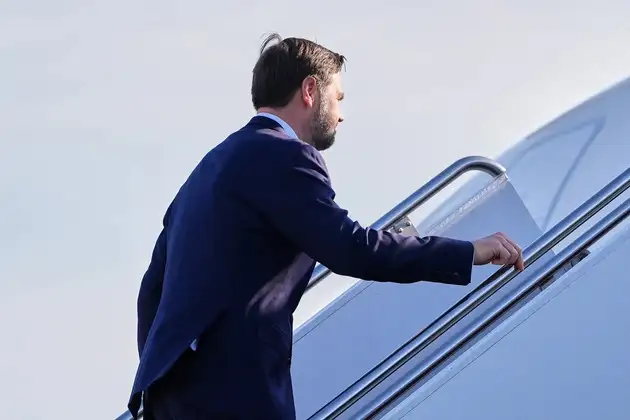
US-Israel Iran War Updates Live:As he departed for the high-stakes summit in Islamabad, Vice President JD Vance signaled a blend of diplomatic openness and strategic skepticism regarding the upcoming talks with Iran. Echoing President Trump's recent stance, Vance emphasized that the United States is prepared to extend an "open hand" provided that the Iranian leadership demonstrates a sincere commitment to negotiating in good faith. However, he balanced this optimism with a stern reminder that the American delegation remains highly vigilant.
Hezbollah announced on Friday that it launched a missile attack against Israel's Ashdod naval base, citing a direct response to a massive Israeli air campaign that killed over 300 people in Beirut earlier this week.
A Saudi refinery operated by TotalEnergies has been shut down following strikes on Friday, the company said, raising fresh concerns over energy supply disruptions in the region.
Meanwhile, Iran's new supreme leader Mojtaba Khamenei said in his latest written message the Islamic republic did not want war with the United States and Israel, but would protect its rights as a nation, state television reported Thursday.
"We did not seek war and we do not want it," he said in the message read out on state TV, weeks after his father, Ayatollah Ali Khamenei, was killed on February 28, the first day of the war.
"But we will not renounce our legitimate rights under any circumstances, and in this respect, we consider the entire resistance front as a whole," he added, in an apparent reference to Lebanon where Israel is fighting with Tehran's ally Hezbollah.
Iran this week agreed to a fragile two-week ceasefire with the United States that could lead to peace negotiations after threats of annihilation from US President Donald Trump. Khamenei told Iranians that they must "not imagine that taking to the streets is no longer necessary" despite the announcement of the ceasefire.
"Your voices in public squares are undoubtedly influential in the outcome of the negotiations," he said, according to the message broadcast on state TV.
Likely wounded in the strike that killed his father, Mojtaba Khamenei, has still not been seen in public since his leadership appointment. He has issued written declarations, most of them read out by presenters on state television.
Israel Iran War Live Updates: Israel military says 30 rockets fired from Lebanon
Iran-backed Hezbollah fired around 30 projectiles from Lebanon into Israel on Friday, the Israeli military said, reporting that some strikes caused damage. Air‑raid sirens were activated across northern Israel near the Lebanese border, where Israeli forces and Hezbollah militants have continued to exchange fire despite a truce in the broader conflict involving Iran. Israeli emergency services reported a strike in Safed, where a direct hit damaged several vehicles.
Israel Iran War Live Updates: Ceasefire sends dollar toward weekly drop with US-Iran talks in focus
Israel Iran War Live Updates: Can the US and Iran bridge deep divides in talks?
Israel Iran War Live Updates: JD Vance departs for Islamabad, optimistic for 'positive' Iran negotiations
Israel Iran War Live Updates: US negotiators to ask Iran to release detained Americans, reports Washington Post
Israel Iran War Live Updates: White House was directly involved in shaping Pak PM's social media post on Iran, says NYT
The White House was “directly involved” in shaping a social media post by Pakistan Prime Minister Shehbaz Sharif in which he “earnestly” requested US President Donald Trump to extend his April 7 deadline on Iran for two weeks, according to a media report. The New York Times said the “White House was directly involved in shaping the message” that was shared on X on Tuesday by Sharif in which wrote "diplomatic efforts for peaceful settlement of the ongoing war in the Middle East are progressing steadily, strongly and powerfully with the potential to lead to substantive results in near future”.
Israel Iran War Live Updates: The man Iran trusts: Can JD Vance succeed where others failed?
Israel Iran War Live Updates: Hezbollah strikes Israeli naval base in retaliation for deadly Beirut raids
In an official statement, the group framed the strike as a punitive measure against what it described as persistent Israeli aggression and the collapse of a standing truce:
"In response to the enemy's violation of the ceasefire and its repeated attacks on Beirut, and after the Resistance adhered to the ceasefire while the enemy did not, the fighters of the Islamic Resistance targeted... the naval base in the port of Ashdod with missiles."
Israel Iran War Live Updates: Hezbollah calls on Lebanon govt to stop giving 'free concessions' to Israel
Israel Iran War Live Updates: How Iran is using bitcoin as gate pass for Hormuz
Israel Iran War Live Updates: Israel approves 34 new West Bank settlements: media, NGO
Israel has approved the establishment of 34 new settlements in the occupied West Bank, according to Israeli media reports and the watchdog Peace Now, which said the decision was taken "secretly" in early April. "The security cabinet secretly decided to establish 34 new settlements," Peace Now said in a statement released late on Thursday.
Israel Iran War Live Updates: Hezbollah says it targeted Israel's Ashdod naval base with missiles
Israel Iran War Live Updates: ASEAN leaders flag rising geopolitical risks
Finance ministers and central bank governors from the Association of Southeast Asian Nations have raised concerns over ongoing tensions in the Middle East, warning of their potential impact on global trade and heightened geopolitical risks. In a joint statement, the leaders emphasized the need to stay vigilant amid evolving global and regional challenges. They also reiterated their commitment to strengthening regional financial integration as a way to cushion the impact of external shocks, including those stemming from the Middle East situation.
Israel Iran War Live Updates: Germany says no oil shortage; some released reserves remain unused
Israel Iran War Live Updates: Netanyahu welcomes Costa Rica move to designate IRGC, Hezbollah, Hamas, Houthis as terror outfits
Israel Iran War Live Updates: Israeli Air Force says 40+ militants killed, 50 infrastructures destroyed in south Lebanon
Israel Iran War Live Updates: Israel claims destruction of 200+ Hezbollah rocket launchers, 250 fighters killed
Israel Iran War Live Updates: Shipping Ministry reviews situation, directs ports to act on exporters’ concerns; 1,927 seafarers repatriated
Israel Iran War Live Updates: EAM visiting Mauritius, to head to UAE for talks on strengthening ties, MEA says
Israel Iran War Live Updates: Iran’s Pezeshkian hails healthcare workers as ‘shining stars’ in war
Israel Iran War Live Updates: Ports told to publish container-related concessions in public domain, Shipping Ministry says
The minister reviewed the current situation today with all ports and org today, directed all of them, and DG shipping to take immediate measures to resolve issues reported to them.
Israel Iran War Live Updates: Crude inventory is sufficient in India, government official says
Israel Iran War Live Updates: Qatar to remain reliable energy supplier to India, Oil Minister Puri says
Israel Iran War Live Updates: Silver futures fall Rs 3,549 to Rs 2,40,219/kg
Silver prices on Friday fell by Rs 3,549 to Rs 2,40,219 per kilogram as participants reduced their bets.
On the Multi Commodity Exchange, silver contracts for the May delivery declined Rs 3,549, or 1.46 per cent, to Rs 2,40,219 per kg in a business turnover of 1,718 lots.
(Source: PTI)
Israel Iran War Live Updates: Former Iranian foreign minister reportedly died after being wounded in airstrike
Israel Iran War Live Updates: TotalEnergies says Saudi refinery shut down after strikes
Israel Iran War Live Updates: US remains ‘absolutely locked into NATO’, says UK Defence Secretary Healey
Israel Iran War Live Updates: IDF details scale of ‘Operation Roaring Lion’ strikes on Iran
Israel Iran War Live Updates: Spain called on Iran to negotiate in 'good faith', minister says
Spain's foreign minister said on Friday that he had spoken with his Iranian counterpart and urged him to negotiate in good faith during talks with the United States in Islamabad.
"I encourage Iran -- this is what I conveyed to the Iranian foreign minister -- to take part in those negotiations and to participate in good faith," Jose Manuel Albares told the press, adding that he had spoken with his Iranian counterpart, Abbas Araghchi, "the day before yesterday" and had also asked him to halt "all missile and drone launches".
Albares once again slammed Israel for continuing its attacks on Lebanon, where it has been fighting Iran-backed militant group Hezbollah.
"Lebanon is a disgrace on the conscience of humanity. The level of violence, the violation of international law and international humanitarian law by Israel is unacceptable," Albares said.
Good to speak with FM Toshimitsu Motegi of Japan. Discussed developments in West Asia, including international shipping through the Strait of Hormuz. Appreciate his condolences for the Indian lives lost in the conflict.
- EAM S Jaishankar
Israel Iran War Live Updates: Oil climbs as strikes on Saudi facilities stoke anxiety, Hormuz near standstill
Oil prices climbed on Friday, driven by fresh anxiety over supplies from Saudi Arabia and as tanker traffic through the critical Strait of Hormuz remained largely frozen.
Prices were still headed for a loss as nerves eased over a fragile two-week ceasefire between the U.S. and Iran, while Israel signalled a potential diplomatic opening, saying it was ready to begin direct talks with Lebanon as soon as possible.
Brent crude futures added 96 cents, or 1%, to $96.88 a barrel as of 0604 GMT. West Texas Intermediate futures were up 78 cents, 0.80%, at $98.65 a barrel.
For this week, both contracts have so far lost about 11%, the biggest weekly decline since June 2025 when the previous Israeli-U.S. strikes on Iran were halted.
Attacks on Saudi energy facilities have cut the kingdom's oil production capacity by around 600,000 barrels per day and throughput on its East-West Pipeline by about 700,000 bpd, Saudi state news agency SPA reported on Thursday, citing an official source at the Ministry of Energy.
Concerns of further oil supply disruptions were heightened after the report, ANZ analysts said in a Friday note.
Israel Iran War Live Updates: Ceasefire sends dollar on weekly drop; US-Iran talks in focus
The dollar headed on Friday for its largest weekly drop since January, as investors sold safe assets on optimism that oil shipping will resume if a ceasefire holds in the Gulf.
The dollar had towered in March as one of the few bastions of safety as the U.S. and Israeli war on Iran sent oil prices rocketing and hit stocks and gold, while inflation worries sank bonds.
But since a shaky ceasefire was agreed on Tuesday those positions are being unwound.
The euro has rallied through its 200-day moving average this week to trade at $1.1694, a break of chart resistance that opens the way to further gains.
The risk-sensitive Australian and New Zealand dollars are looking at weekly rises of nearly 3% on the dollar, with the Aussie trading just above 70 cents and the kiwi at $0.5847. Sterling has shot up 1.8% this week and above its 200-day moving average to $1.3424.
Israel Iran War Live Updates: China lets state oil firms tap commercial reserves as Iran war drags on: Report
The Chinese government has given state refiners the green light to tap commercial oil reserves as the Iran war drags on, Bloomberg News reported on Thursday, citing people familiar with the matter.
Refiners including Sinopec and China National Petroleum will be able to tap commercial inventories held at processing plants or in storage facilities, the report added.
Reuters could not immediately verify the report.
Israel Iran War Live Updates: US summons Iraqi ambassador over drone strike on diplomatic facility in Baghdad
U.S. Deputy Secretary of State Christopher Landau summoned Iraqi Ambassador Nizar Khirullah on Thursday after a drone struck a major U.S. diplomatic facility in Baghdad, the State Department said in a statement.
The U.S. Embassy in Baghdad said earlier that Iraqi "terrorist militias," who Washington accused of being aligned with Iran, had conducted multiple drone attacks near the Baghdad Diplomatic Support Center and Baghdad International Airport on Wednesday.
The State Department said Landau acknowledged the Iraqi security forces' efforts to respond while emphasizing "the Iraqi government's failure to prevent these attacks."
The State Department said Washington expects the Iraqi government to take measures to dismantle Iran-aligned militia groups in Iraq.
It also said that "some elements associated with the Iraqi government continue to actively provide political, financial, and operational cover for the militias."
Dozens of people have been killed in Iraq since the start of the Iran war, according to Iraqi health authorities. Those include civilians, members of the Iran-affiliated Shi'ite Popular Mobilisation Forces, U.S.-allied Kurdish Peshmerga fighters, police and army.
Israel Iran War Live Updates: Air raid sirens across Israel after rocket launches from Lebanon
Air raid alerts rang out across Israel early Friday, including in the commercial hub of Tel Aviv and in the southern coastal city of Ashdod following rocket fire from Lebanon.
Continued fighting between Israel and Iran-backed Hezbollah is testing a fragile truce reached between the United States and Iran.
Israel and Hezbollah exchanged fire repeatedly on Thursday.
The Israeli army's Home Front Command issued alerts for several areas following Friday's rocket fire, including the Tel Aviv area and southern communities far from the Lebanon border.
There were no immediate reports of casualties, but Israeli media reported that air-defence systems had intercepted at least one incoming rocket.
Hezbollah posted several statements on Telegram saying it had launched three waves of rocket and drone strikes in the early hours of the morning against Israeli soldiers on both sides of the border as well as a town in northern Israel.
Israel Iran War Live Updates: Israeli military says Hezbollah launched missile at Israel, triggering sirens
Israel's military said on Friday that Hezbollah had launched a missile at Israel, triggering air raid sirens in parts of the country, including in Tel Aviv.
Hezbollah said it targeted "Israeli military" infrastructure in the northern city of Haifa in the late hours of Thursday.
Israel Iran War Live Updates: Kuwait says drone attack caused significant damage
Kuwait said drones were fired towards its territory and caused significant damage, the first attack reported in the Gulf on Thursday as the ceasefire between Iran and the United States entered its second day.
The Kuwaiti National Guard said in a statement that the attack targeted one of its sites, "causing significant damage, without wounding anyone".
The army had earlier said that its air defences were "currently facing hostile drone attacks that have penetrated the country's airspace, targeting several vital installations".
The Gulf countries have been targeted by hundreds of Iranian missiles and drones since the beginning of the war, which was triggered by Israeli-US strikes on Iran on February 28.
Israel Iran War Live Updates: Operational activities halted at several energy facilities in Saudi Arabia
Operational activities have been halted at several energy facilities in Saudi Arabia due to recent attacks, Saudi state news agency SPA reported on Thursday citing an official source at the ministry of energy.
The attacks resulted in the death of one Saudi national from the industrial security personnel of the Saudi energy company, SPA added.
Israel Iran War Live Updates: Trump says Iran doing ‘very poor job’ of allowing oil through Strait of Hormuz
“Iran is doing a very poor job, dishonorable some would say, of allowing Oil to go through the Strait of Hormuz,” he wrote on his social media site Thursday evening.
“That is not the agreement we have!”
The post came after Trump posted earlier that “There are reports that Iran is charging fees to tankers going through the Hormuz Strait – They better not be and, if they are, they better stop now!”
The White House supports reopening the strait as part of the ceasefire deal, but says that Trump opposes Iran's military, which continues to control the waterway, from seeking to raise revenue by charging tolls on passing ships.
Israel Iran War Live Updates: Netanyahu authorizes direct talks with Lebanon in potential boost to ceasefire efforts
In a potential boost to Middle East ceasefire efforts, Israeli Prime Minister Benjamin Netanyahu said Thursday that he authorized direct negotiations with Lebanon “as soon as possible” aimed at disarming Iranian-backed Hezbollah militants and establishing relations between the neighbors.
The two countries have technically been at war since Israel was established in 1948, and Netanyahu later stressed that there was no ceasefire between them. In a video statement, he said Israel will keep striking Hezbollah until security is restored in northern Israel.
There was no immediate response from Lebanon. But Israel-Lebanon negotiations were expected to begin next week at the State Department in Washington, according to a U.S. official and a person familiar with the plans, who spoke on condition of anonymity due to the delicacy of the matter.
The prospect of talks appeared to bolster the tentative ceasefire in the Iran war that has staggered under the weight of Israel’s bombardment of Beirut, Tehran’s continued chokehold on the Strait of Hormuz and uncertainty over whether talks can find common ground.
However later Thursday, U.S. President Donald Trump appeared to cast doubt on the effectiveness of the ceasefire, writing on his social media platform: “Iran is doing a very poor job, dishonorable some would say, of allowing Oil to go through the Strait of Hormuz.”
Israel Iran War Live Updates: Trump slams right-wing commentators who oppose Iran war
US President Donald Trump on Thursday angrily lashed out at multiple well-known conservative commentators who have criticized his war against Iran, slamming his onetime allies as attention-seeking "NUT JOBS."
"They're stupid people, they know it, their families know it, and everyone else knows it, too!" Trump wrote in a nearly 500-word social media post.
In the president's crosshairs were Tucker Carlson and Megyn Kelly -- two former Fox News hosts turned independent podcasters -- as well as Candace Owens and Alex Jones, also podcasters and prominent conspiracy theorists.
All four have vocally criticized Trump over the war, slamming him for abandoning his anti-war campaign promises and -- to varying degrees -- accusing him of bowing to pressure from Israel to launch the conflict.
Their criticism has highlighted a divide among American conservatives over the war, a potential major political risk for Trump's Republican Party heading into the November midterm elections.
Israel Iran War Live Updates: Trump warns Iran not to charge fees for ships transiting Hormuz
Israel Iran War Live Updates: Iran 'does not seek war', says supreme leader Mojtaba Khamenei; vows not to 'renounce legitimate rights'
"We did not seek war and we do not want it," he said in the message read out on state TV, weeks after his father, Ayatollah Ali Khamenei, was killed on February 28, the first day of the war.
"But we will not renounce our legitimate rights under any circumstances, and in this respect, we consider the entire resistance front as a whole," he added, in an apparent reference to Lebanon where Israel is fighting with Tehran's ally Hezbollah.
Iran this week agreed to a fragile two-week ceasefire with the United States that could lead to peace negotiations after threats of annihilation from US President Donald Trump. Khamenei told Iranians that they must "not imagine that taking to the streets is no longer necessary" despite the announcement of the ceasefire.
"Your voices in public squares are undoubtedly influential in the outcome of the negotiations," he said, according to the message broadcast on state TV.
Likely wounded in the strike that killed his father, Mojtaba Khamenei, has still not been seen in public since his leadership appointment. He has issued written declarations, most of them read out by presenters on state television.

