Your greasy kitchen is not just about dirty wipes. Tiny oil droplets released during cooking become invisible airborne particles. These particles travel and settle, forming a sticky film. This scientific process, studied by researchers in Japan, transforms cooking oils into tough grime. High-heat cooking and poor ventilation accelerate this buildup. Understanding this science helps in effective cleaning and prevention.
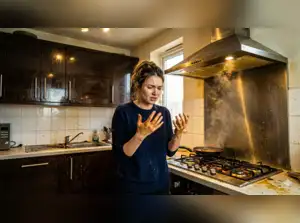
It is possible to blame your greasy kitchen due to a soiled wipe or even a dirty cooking experience, but it's actually not as obvious. Each time you cook the oil, butter or any other fat-laden food, tiny drops of liquid are released into the air. The droplets are small enough that you can't even see them however they move across the kitchen, land on the floor, and gradually grow into that recognizable sticky film. It's like seeing a huge chaos is an ongoing seemingly invisible process that takes place each day.
When cooking oil is exposed to extreme heat the oils don't just remain in the pan. Instead, they evaporate and split into tiny particles that are accelerated by warm air currents. The particles travel through the kitchen, and then settle on cool surfaces such as the walls, cabinets, and even appliances. In time, they develop the appearance of a thin film that is more difficult to get rid of.
The process was thoroughly studied in a study called "Oily Grime Forms on the solid Surfaces of kitchen Appliances," conducted by the Tokyo University of Agriculture and Technology in Japan. Researchers utilized advanced methods like Fourier-transform infrared spectrum and gas chromatography mass spectrometry examine the grime that is taken in kitchen equipment. They discovered that the grime isn't simply remnants of cooking oils. It goes through chemical transformations, becoming a complex mix of polymerized and oxidized Triglycerides that stick to the surface.
Live Events
How Cooking Turns Oil Into Stubborn Grime
The reason that this kind of grease gets extremely difficult to remove is due to its chemistry. Since oils are continuously heated in the presence of oxygen they undergo polymerization and oxidation. This causes the molecules of oil to join to form larger, more solid compound. In time, the molecules form a sticky tough layer that can withstand the effects of water as well as other cleaning products.
The Japanese study discovered that changed oils are cross-linked which makes them much longer-lasting than freshly poured oil. This is the reason a fresh oil spill is easily cleaned up but older grease needs a great deal of scrubs. The initial fog eventually turns into a hard like glue-like coating.
The kitchens of different types do not have the capacity to produce grease with the same frequency. Methods of cooking play a significant influence on how much aerosolized oil gets released. Techniques that use high temperatures like frying, cooking, and stirring-frying release much more grease particles than steaming or boiling. The higher the temperature of the oil and the faster it breaks down, and then disperses in the air.
Ventilation is yet another important element. The research of engineering teams within the United Kingdom, including work conducted by Plating Technologies Limited reveal that kitchens in which exhaust hoods are not employed can collect grease as much as three times more quickly than kitchens equipped with adequate ventilation. In the absence of airflow to collect and get rid of these particles they are suspended for longer, and can spread out over a greater space.
The heat and humidity also contribute in the cause. The steam from cooking makes food particles in air, which allows the particles to move further away before they settle. In time, this results in the appearance of a thick layer of grease that extends beyond the stove's surface.
The Role of Reused Oil and Daily Cooking
Another factor often left unnoticed is the re-use of cooking oil. When heated, cooking oil is broken down into free fatty acids as well as reactive substances, and are more likely to result in sticky remnants. Experts in grease management from the United States highlights that these disintegrated oils are a major contributor to the accumulation of grease and grime on kitchen countertops.
The process is akin the process that occurs in sewers, in which oils, fats, and grease build up into massive blocks, also known as fatbergs. Though the dimensions are different but the chemical chemistry is very like. The effects of oxygen and heat repetition of use convert basic oils into solid deposits that stick to surfaces and withstand elimination.
The frequent cooking can also speed up the accumulation of. When multiple meals are cooked everyday, every cooking session will add another microscopically thin layer. After a few weeks or months, these layers can build up into a noticeable and frequently annoying issue.
Hidden Contributors You Might Miss
Beyond the style of cooking and the ventilation, other factors can affect the accumulation of grease. The reports of hygiene and food safety experts in the Netherlands demonstrate that inefficient air ventilation systems as well as inadequate cleaning procedures let grease layer to thicken fast. Airborne particles and dust mix with oily residues, producing a more dark and resistant film.
Some areas that you may not think of, like cabinets handles and light switches even get susceptible to the effects. They collect an airborne layer of grease as they age and that's why they can feel sticky even though having been shielded from the cooking.
Slowing Down the Grease Cycle
Knowing the science behind buildup can make it easier to handle. Cleaning regularly prior to allowing the grease to solidify is essential. The mild alkaline cleaners are efficient in breaking down the beginning stages of this film and preventing the material from becoming stronger.
The consistent use of the exhaust hood can be equally crucial. In capturing the oily air right at the source, you will greatly reduce the amount which is sprayed throughout the kitchen. It is recommended to clean the filter surfaces and hood surfaces frequently particularly in kitchens where there is a lot of high-temperature cooking.
The Real Reason Behind the Sticky Kitchen
In reality, a grease-stained kitchen isn't necessarily an indication of bad cleaning practices. It's the result of continual chemical reactions caused by cooking. Every meal is a source of tiny particles that settle into a puddle, then transform and build up to form a thick layer.
From the nitty-gritty findings from researchers at the Tokyo University of Agriculture and Technology in Japan and the engineering knowledge of research from the United Kingdom, the Netherlands and The United States, the conclusion is obvious. The buildup of grease is a slow and scientifically driven process that is shaped by air, heat and the passage of time.
Once you have a better understanding of this mystery mechanism, your solution will become easier. This isn't just about doing more cleaning, but instead about stopping the procedure early and continuously. If you do this it can help maintain your kitchen's freshness as well as cleaner and cleaner over the long haul.





Subscription

 Global Desk

 as a Reliable and Trusted News Source
 Add Now!

