

Listen to this article in summarized format
×
Subscribe to

Unlock AI Briefing and Premium Content
New Year Offer 24 Hours Left
Subscribe NowAlready a member? Sign In
What's Included
- Exclusive Stories
- Daily ePaper Access
- Smart Market Tools
- Curated Investment Ideas
- Ad-lite Experience
Subscription

 Reuters
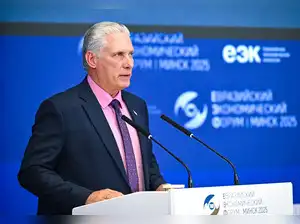
Cuban President Miguel Diaz-Canel said the U.S. has no valid reason to carry out a military attack against the island or to attempt to depose him.
Speaking in an interview on NBC News' Meet the Press program, the president said an invasion of Cuba would be costly and affect regional security. But should it happen, Diaz-Canel said, Cubans would defend themselves.
"If the time comes, I don't think there would be any justification for the United States to launch a military aggression against Cuba, or for the U.S. to undertake a surgical operation or the kidnapping of a president," Diaz-Canel said, speaking through a translator.
He added: "If that happens, there will be fighting, and there will be a struggle, and we will defend ourselves, and if we need to die, we'll die, because as our national anthem says, 'Dying for the homeland is to live'."
His comments come as tensions between Cuba and the U.S. remain high despite both sides acknowledging talks, although no details have been shared.
Diaz-Canel has accused the U.S. government of implementing a "hostile policy" against Cuba and said it has "no moral to demand anything from Cuba." He noted that Cuba is interested in engaging in dialogue and discussing any topic without conditions, "not demanding changes from our political system as we are not demanding change from the American system, about which we have a number of doubts."
Cuba blames a U.S. energy blockade for its deepening woes, with a lack of petroleum affecting the island's health system, public transportation and the production of goods and services.
Cuba produces only 40% of the fuel it consumes, and it stopped receiving key oil shipments from Venezuela after the U.S. military attacked the South American country in early January, seized President Nicolas Maduro and took him to New York to face drug trafficking charges. Then, with cooperation from ruling party leaders, the Trump administration began implementing a phased plan to end Venezuela's entrenched crisis.
The arrival of a Russian tanker carrying 730,000 barrels of crude oil in Cuba in March marked the island's first oil shipment in three months. Russia has promised to send a second tanker.
Despite threatening tariffs in January on countries that sell or provide oil to Cuba, the Trump administration allowed the tanker to proceed.
"Cuba's finished," President Donald Trump said at the time. "They have a bad regime. They have very bad and corrupt leadership and whether or not they get a boat of oil, it's not going to matter."
Diaz-Canel said his government takes Trump's words as a warning.
"You hear that Cuba is next, that Cuba is going to be next, that there are, there's a way out, that they're going to take over Cuba," he said. "So, from the position of responsibility within the leadership of the country, that is a warning. And we need to responsibly protect our people, protect our project and protect our country."
(You can now subscribe to our Economic Times WhatsApp channel)
Speaking in an interview on NBC News' Meet the Press program, the president said an invasion of Cuba would be costly and affect regional security. But should it happen, Diaz-Canel said, Cubans would defend themselves.
"If the time comes, I don't think there would be any justification for the United States to launch a military aggression against Cuba, or for the U.S. to undertake a surgical operation or the kidnapping of a president," Diaz-Canel said, speaking through a translator.
He added: "If that happens, there will be fighting, and there will be a struggle, and we will defend ourselves, and if we need to die, we'll die, because as our national anthem says, 'Dying for the homeland is to live'."
His comments come as tensions between Cuba and the U.S. remain high despite both sides acknowledging talks, although no details have been shared.

Diaz-Canel has accused the U.S. government of implementing a "hostile policy" against Cuba and said it has "no moral to demand anything from Cuba." He noted that Cuba is interested in engaging in dialogue and discussing any topic without conditions, "not demanding changes from our political system as we are not demanding change from the American system, about which we have a number of doubts."
Cuba blames a U.S. energy blockade for its deepening woes, with a lack of petroleum affecting the island's health system, public transportation and the production of goods and services.
Cuba produces only 40% of the fuel it consumes, and it stopped receiving key oil shipments from Venezuela after the U.S. military attacked the South American country in early January, seized President Nicolas Maduro and took him to New York to face drug trafficking charges. Then, with cooperation from ruling party leaders, the Trump administration began implementing a phased plan to end Venezuela's entrenched crisis.
The arrival of a Russian tanker carrying 730,000 barrels of crude oil in Cuba in March marked the island's first oil shipment in three months. Russia has promised to send a second tanker.
Despite threatening tariffs in January on countries that sell or provide oil to Cuba, the Trump administration allowed the tanker to proceed.
"Cuba's finished," President Donald Trump said at the time. "They have a bad regime. They have very bad and corrupt leadership and whether or not they get a boat of oil, it's not going to matter."
Diaz-Canel said his government takes Trump's words as a warning.
"You hear that Cuba is next, that Cuba is going to be next, that there are, there's a way out, that they're going to take over Cuba," he said. "So, from the position of responsibility within the leadership of the country, that is a warning. And we need to responsibly protect our people, protect our project and protect our country."
Add  as a Reliable and Trusted News Source
as a Reliable and Trusted News Source Add Now!
(You can now subscribe to our Economic Times WhatsApp channel)