
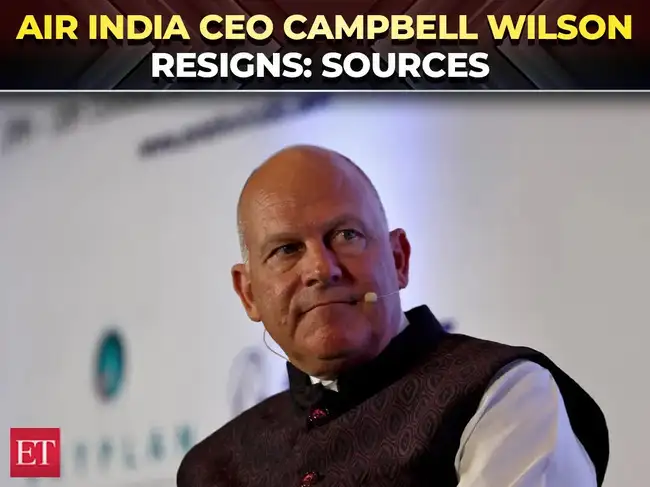
Air India’s CEO Campbell Wilson has stepped down, the airline said, after a year in which the Tata Group-owned carrier faced a series of operational, regulatory and financial challenges following a fatal crash.
The timing, though, is hard to ignore.
Campbell’s exit comes within weeks of a leadership change at IndiGo, where CEO Pieter Elbers resigned after a period marked by widespread flight disruptions, placing both of India’s largest airlines in transition after months of strain.
Together, Air India and IndiGo dominate India’s aviation market, and the past year has seen both carriers tested in different ways.
Also read: Air India CEO Campbell Wilson resigns after Ahmedabad crash, airspace closure trouble Tata-owned carrier
In the months that followed, regulatory concerns extended beyond the crash. ET had reported that Air India was reprimanded for safety lapses, including flying an aircraft multiple times without a valid airworthiness certificate and operating planes without checking emergency equipment. The airline later acknowledged the need for improvements in compliance and internal processes.
At the same time, the airline’s turnaround faced pressure from external factors. Pakistan’s closure of its airspace to Indian carriers forced longer routes on key international sectors, increasing fuel consumption and operating costs.
The conflict in West Asia added to the disruption. In a note to employees in March, Wilson said Air India had cancelled around 2,500 flights to the region over three weeks and was operating at about 30% of its normal Middle East schedule due to restricted airspace and airport closures, warning of a significant financial impact.
These disruptions affected routes to Europe and North America, with flights being rerouted and costs rising as a result.
Financial pressure continued to build. Air India and its low-cost arm reported a combined loss of ₹98.08 billion in 2024-25, even as the airline continued to invest in fleet expansion and refurbishment.
Also read: 'Time is right...': What Campbell Wilson said on his resignation from Air India
In December 2025, the airline saw widespread disruption, cancelling around 4,500 flights in the first weeks of the month. The carrier later said it had failed to update crew rosters in time to comply with stricter pilot fatigue regulations.
A government response in Parliament pointed to a set of underlying issues, including over-optimisation of operations, gaps in regulatory preparedness and shortcomings in system support and operational control.
The fallout led to tighter oversight, with authorities increasing monitoring of airline operations and stepping up checks on crew availability, roster integrity and system robustness.
The disruption had consequences at the top. Elbers stepped down in March, with managing director Rahul Bhatia taking interim charge, according to a regulatory filing by the airline.
Airlines faced higher fuel prices, increased insurance costs linked to conflict zones and operational challenges linked to restricted airspace.
IndiGo’s operations were also affected by these conditions, even as it managed the fallout from the December disruptions and continued its expansion.
For Air India, the leadership change comes as the airline continues its turnaround under Tata Group ownership.
(You can now subscribe to our Economic Times WhatsApp channel)
The timing, though, is hard to ignore.
Campbell’s exit comes within weeks of a leadership change at IndiGo, where CEO Pieter Elbers resigned after a period marked by widespread flight disruptions, placing both of India’s largest airlines in transition after months of strain.
Together, Air India and IndiGo dominate India’s aviation market, and the past year has seen both carriers tested in different ways.
Also read: Air India CEO Campbell Wilson resigns after Ahmedabad crash, airspace closure trouble Tata-owned carrier

Air India: From crash to scrutiny
For Air India, the sequence of events began with the June 2025 crash of a Boeing 787 near Ahmedabad that killed 260 people. The incident triggered intense scrutiny from regulators and placed the airline’s operations under closer watch.In the months that followed, regulatory concerns extended beyond the crash. ET had reported that Air India was reprimanded for safety lapses, including flying an aircraft multiple times without a valid airworthiness certificate and operating planes without checking emergency equipment. The airline later acknowledged the need for improvements in compliance and internal processes.
At the same time, the airline’s turnaround faced pressure from external factors. Pakistan’s closure of its airspace to Indian carriers forced longer routes on key international sectors, increasing fuel consumption and operating costs.
The conflict in West Asia added to the disruption. In a note to employees in March, Wilson said Air India had cancelled around 2,500 flights to the region over three weeks and was operating at about 30% of its normal Middle East schedule due to restricted airspace and airport closures, warning of a significant financial impact.
These disruptions affected routes to Europe and North America, with flights being rerouted and costs rising as a result.
Financial pressure continued to build. Air India and its low-cost arm reported a combined loss of ₹98.08 billion in 2024-25, even as the airline continued to invest in fleet expansion and refurbishment.
Also read: 'Time is right...': What Campbell Wilson said on his resignation from Air India
IndiGo: December disruption and fallout
While Air India was dealing with safety scrutiny and external disruptions, IndiGo faced a crisis of its own at the end of the year.In December 2025, the airline saw widespread disruption, cancelling around 4,500 flights in the first weeks of the month. The carrier later said it had failed to update crew rosters in time to comply with stricter pilot fatigue regulations.
A government response in Parliament pointed to a set of underlying issues, including over-optimisation of operations, gaps in regulatory preparedness and shortcomings in system support and operational control.
The fallout led to tighter oversight, with authorities increasing monitoring of airline operations and stepping up checks on crew availability, roster integrity and system robustness.
The disruption had consequences at the top. Elbers stepped down in March, with managing director Rahul Bhatia taking interim charge, according to a regulatory filing by the airline.
A chain of pressures, two exits
The pressures on both airlines unfolded against a backdrop of rising costs, regulatory changes and geopolitical uncertainty.Airlines faced higher fuel prices, increased insurance costs linked to conflict zones and operational challenges linked to restricted airspace.
IndiGo’s operations were also affected by these conditions, even as it managed the fallout from the December disruptions and continued its expansion.
For Air India, the leadership change comes as the airline continues its turnaround under Tata Group ownership.
Add  as a Reliable and Trusted News Source
as a Reliable and Trusted News Source Add Now!
(You can now subscribe to our Economic Times WhatsApp channel)
(Catch all the Business News, Breaking News and Latest News Updates on The Economic Times.)
Subscribe to The Economic Times Prime and read the ET ePaper online.
Read More News on
(Catch all the Business News, Breaking News and Latest News Updates on The Economic Times.)
Subscribe to The Economic Times Prime and read the ET ePaper online.






 ETPrime Membership