
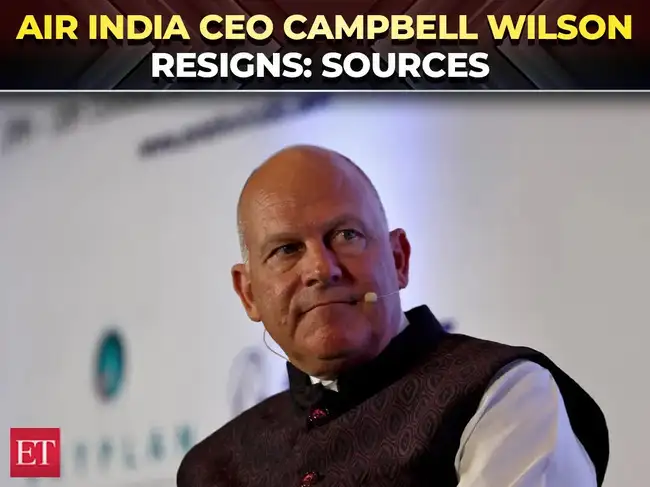
Air India Chief Executive Officer (CEO) Campbell Wilson announced his resignation on Monday, as the airline grapples with persistent losses and increased regulatory scrutiny following a Boeing plane crash last year that killed 260 people.
Appointed on a five-year contract in 2022, Campbell's tenure as Air India CEO is scheduled to conclude in July 2027. Although, he had conveyed his intention to step down in 2026 to the airline's Chairman N. Chandrasekaran in 2024 and, since then, has been working to ensure the organization and leadership team is on a stable footing for the transition.
The Tata-owned carrier clarified that he will remain in the role until his successor is announced and in place.
Air India has been grappling with multiple pain points, especially amid adverse geopolitical conditions and a turbulent Indian market.
Also read: Air India, Tata Digital losses push Tata Sons’ new ventures towards Rs 29,000 crore hit
Among a clutch of loss-making ventures, Air India remains the single largest contributor to the company's woes, with FY26 losses projected to touch Rs 20,000 crore, which is ten times higher than an earlier estimate of Rs 2,000 crore. A major pie of Rs 15,000 crore loss has already been recorded in the first nine months. This compares with Rs 11,000 crore in FY25.
The report by The Times of India pointed to multiple external pressures behind the carrier's loss, including Pakistan’s airspace closure, elevated crude prices above $100, and the Ahmedabad flight crash, describing the situation as a “perfect storm” for the airline.
The Indian carrier, which has a fleet of 191 Boeing and Airbus planes, has lost money since being acquired by Tata in 2022, with the financial pressure worsening since Pakistan banned Indian carriers from its airspace last year.
Amid challenging geopolitical times, a prolonged war between US-Israel and Iran can add further pressure on Air India's lucrative western routes, already scaled back due to Pakistan's restrictions.
Also read: Air India finds large-scale misuse of its leisure travel policy for staff, initiates corrective actions
Earlier in December, Air India admitted there was a "need for urgent improvements in process discipline, communication, and compliance culture," as reported by Reuters.
Air India is chaired by N. Chandrasekaran, who is also the chairman of the Tata Group. Alongside Tata, Singapore Airlines holds a 25% stake in Air India.
“Holding management fully accountable for Air India's FY26 losses would be ‘unfair and analytically lazy’," Thomas Kuruvilla, managing partner of Arthur D Little, told ToI, cautioning against placing the entire burden on management.
Kuruvilla highlighted that the real question is not whether management caused the losses-they didn't-but whether they built enough financial resilience to absorb shocks of this scale. "That answer is less comfortable."
The partner at Arthur D Little drew a distinction between external challenges and service quality. “While ‘geopolitics excuses the financials, it does not excuse the customer experience’.”
“Four years into private ownership, service consistency should not still be generating the same complaints it inherited from the govt. ‘The external environment may be brutal, but inside the cabin, that is entirely Tata's problem to own,’” Kuruvilla said.
Wilson began his career with SIA in 1996 as a Management Trainee in New Zealand. Subsequently, he held various roles with SIA in Canada, Hong Kong, and Japan, before returning to Singapore in 2011 as the founding CEO of Scoot, a position he held until 2016.
The aviation veteran then served as Senior Vice President - Sales & Marketing at SIA, where he managed Pricing, Distribution, eCommerce, Merchandising, Brand & Marketing, Global Sales, and the airline's overseas offices. In April 2020, Wilson returned for a second stint as CEO of Scoot.
He holds a Master of Commerce (First Class Honours) in Business Administration from the University of Canterbury, New Zealand.
(You can now subscribe to our Economic Times WhatsApp channel)
Appointed on a five-year contract in 2022, Campbell's tenure as Air India CEO is scheduled to conclude in July 2027. Although, he had conveyed his intention to step down in 2026 to the airline's Chairman N. Chandrasekaran in 2024 and, since then, has been working to ensure the organization and leadership team is on a stable footing for the transition.
The Tata-owned carrier clarified that he will remain in the role until his successor is announced and in place.
Air India has been grappling with multiple pain points, especially amid adverse geopolitical conditions and a turbulent Indian market.
Also read: Air India, Tata Digital losses push Tata Sons’ new ventures towards Rs 29,000 crore hit

Trouble mounts for Tata-owned airline
A cluster of new businesses within Tata Sons group is projected to post a combined loss of around Rs 29,000 crore in FY26, far exceeding an earlier estimate of Rs 5,700 crore, according to a report by The Times of India’s Reeba Zachariah, based on internal estimates.Among a clutch of loss-making ventures, Air India remains the single largest contributor to the company's woes, with FY26 losses projected to touch Rs 20,000 crore, which is ten times higher than an earlier estimate of Rs 2,000 crore. A major pie of Rs 15,000 crore loss has already been recorded in the first nine months. This compares with Rs 11,000 crore in FY25.
The report by The Times of India pointed to multiple external pressures behind the carrier's loss, including Pakistan’s airspace closure, elevated crude prices above $100, and the Ahmedabad flight crash, describing the situation as a “perfect storm” for the airline.
The Indian carrier, which has a fleet of 191 Boeing and Airbus planes, has lost money since being acquired by Tata in 2022, with the financial pressure worsening since Pakistan banned Indian carriers from its airspace last year.
Amid challenging geopolitical times, a prolonged war between US-Israel and Iran can add further pressure on Air India's lucrative western routes, already scaled back due to Pakistan's restrictions.
Also read: Air India finds large-scale misuse of its leisure travel policy for staff, initiates corrective actions
Earlier in December, Air India admitted there was a "need for urgent improvements in process discipline, communication, and compliance culture," as reported by Reuters.
Air India is chaired by N. Chandrasekaran, who is also the chairman of the Tata Group. Alongside Tata, Singapore Airlines holds a 25% stake in Air India.
“Holding management fully accountable for Air India's FY26 losses would be ‘unfair and analytically lazy’," Thomas Kuruvilla, managing partner of Arthur D Little, told ToI, cautioning against placing the entire burden on management.
Kuruvilla highlighted that the real question is not whether management caused the losses-they didn't-but whether they built enough financial resilience to absorb shocks of this scale. "That answer is less comfortable."
The partner at Arthur D Little drew a distinction between external challenges and service quality. “While ‘geopolitics excuses the financials, it does not excuse the customer experience’.”
“Four years into private ownership, service consistency should not still be generating the same complaints it inherited from the govt. ‘The external environment may be brutal, but inside the cabin, that is entirely Tata's problem to own,’” Kuruvilla said.
Campbell Wilson's aviation career
Campbell Wilson was appointed as CEO and Managing Director (MD) of Air India in 2022 with over 30 years of rich experience in the aviation industry. The veteran has worked across both full-service and low-cost carriers, and served as CEO of Scoot, the wholly-owned low-cost subsidiary of Singapore Airlines (SIA).Wilson began his career with SIA in 1996 as a Management Trainee in New Zealand. Subsequently, he held various roles with SIA in Canada, Hong Kong, and Japan, before returning to Singapore in 2011 as the founding CEO of Scoot, a position he held until 2016.
The aviation veteran then served as Senior Vice President - Sales & Marketing at SIA, where he managed Pricing, Distribution, eCommerce, Merchandising, Brand & Marketing, Global Sales, and the airline's overseas offices. In April 2020, Wilson returned for a second stint as CEO of Scoot.
He holds a Master of Commerce (First Class Honours) in Business Administration from the University of Canterbury, New Zealand.
Add  as a Reliable and Trusted News Source
as a Reliable and Trusted News Source Add Now!
(You can now subscribe to our Economic Times WhatsApp channel)
(Catch all the Business News, Breaking News and Latest News Updates on The Economic Times.)
Subscribe to The Economic Times Prime and read the ET ePaper online.
(Catch all the Business News, Breaking News and Latest News Updates on The Economic Times.)
Subscribe to The Economic Times Prime and read the ET ePaper online.






 ETPrime Membership